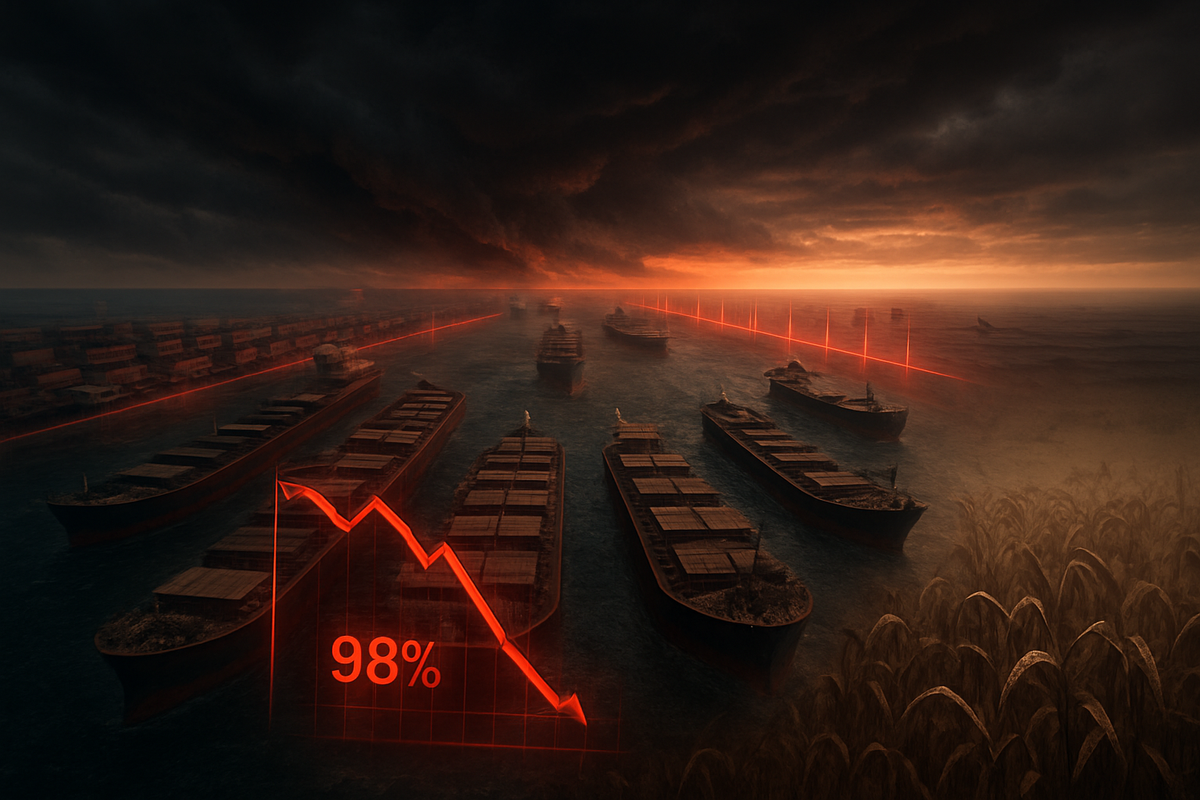
As of April 7, 2026, the global agricultural supply chain is facing an existential crisis. Following the escalation of regional hostilities in late February—a conflict now commonly referred to by military analysts as "Operation Epic Fury"—the Strait of Hormuz has been effectively shuttered to commercial traffic. The consequences for global food security are staggering: new data from maritime tracking agencies and the Asian Development Bank (ADB) reveal a catastrophic 98% drop in fertilizer exports through the strait during the month of March 2026.
The implications of this maritime blockade extend far beyond the borders of the Middle East. With dozens of fully loaded bulk carriers currently stranded in the Persian Gulf, unable to navigate mine-laden waters or secure war-risk insurance, the world’s "breadbaskets" are running on empty. From the cornfields of the American Midwest to the rice paddies of Southeast Asia, the sudden disappearance of Middle Eastern nitrogen and phosphorus is threatening to trigger a multi-year global food shortage.
A Month of Silence: The 98% Drop and the "Sulfur Cascade"
The collapse of trade flows began in earnest on February 26, 2026, when a series of kinetic engagements and "sea deniability" strikes led to the total suspension of commercial insurance for the Strait of Hormuz. By March 13, 2026, the ADB reported that vessel traffic had slowed to a near-halt, with fertilizer shipments falling from millions of tons per week to a mere trickle. This 98% drop represents the most sudden and severe disruption to agricultural inputs in modern history.
The crisis is not just about the finished product; it is about the "sulfur cascade." Roughly 44% to 50% of the world’s seaborne sulfur—a critical feedstock used to manufacture phosphate fertilizers—is produced as a byproduct of oil and gas refining in the Persian Gulf. With the strait closed, this sulfur is trapped behind the blockade. This has created a secondary shockwave, paralyzing phosphate production plants in Morocco and China that rely on Middle Eastern sulfur to process raw rock into usable fertilizer.
Market Fallout: The Winners and Losers of the Blockade
The geopolitical lockdown has created a stark divide in the financial markets between those with domestic production and those reliant on the Gulf's artery. Saudi Arabian Mining Co (TADAWUL: 1211), also known as Ma’aden, has seen its export revenue evaporate overnight. As one of the world’s largest phosphate exporters, Ma’aden has dozens of vessels loaded with Diammonium Phosphate (DAP) sitting idle at the Port of Ras Al Khair. Similarly, Saudi Basic Industries Corp (TADAWUL: 2010), or SABIC, has been forced to curtail production at its massive nitrogen facilities as storage tanks reach capacity with nowhere to ship the product.
In the shipping sector, A.P. Moller - Maersk (CPH: MAERSK-B) and other major carriers are grappling with an operational nightmare. Rerouting vessels around the Cape of Good Hope has added over $1 million in fuel costs per voyage and up to three weeks of transit time, though even these routes are irrelevant for the cargo currently trapped inside the Persian Gulf.
Conversely, North American producers are seeing a dramatic, albeit volatile, upside. CF Industries Holdings, Inc. (NYSE: CF), the world’s largest pure-play nitrogen producer, has seen its stock surge over 70% year-to-date as it benefits from its location outside the conflict zone and access to low-cost U.S. natural gas. The Mosaic Company (NYSE: MOS) has also seen its shares hit multi-year highs due to skyrocketing phosphate prices, although its margins are being squeezed by the doubling of sulfur costs required for its production processes. Nutrien Ltd. (NYSE: NTR) is also being watched closely as a potential "white knight" for global potash and nitrogen supply.
A Threat to U.S. Soil: The Long-Term Import Risk
The closure has exposed a significant vulnerability in U.S. agricultural independence. While the U.S. is a powerhouse in nitrogen production, it remains dangerously dependent on the Middle East for phosphorus. Saudi Arabia has historically been a top-four global exporter of phosphate and a leading supplier to the American market. With the Strait of Hormuz closed, the U.S. faces a long-term threat to its phosphorus and nitrogen imports, which typically account for about 20% and 18% of domestic consumption, respectively.
This event differs fundamentally from the 2022 Russia-Ukraine crisis. While Russian fertilizers were eventually rerouted through alternative rail and port systems, the 2026 Hormuz closure is a physical blockage with no viable alternative for the massive volumes of urea and ammonia produced in Qatar and the UAE. Unlike the 1980s "Tanker War," which primarily targeted oil, this conflict has weaponized the very inputs required for life, creating a "double hit" for farmers who face record-high input costs while grain prices remain stagnant due to the lack of a corresponding grain shortage from the Gulf region.
The Path Forward: Military Escorts or Strategic Pivots?
In the short term, the international community is debating the implementation of multilateral naval escorts—a modern-day "Operation Earnest Will"—to shepherd fertilizer and LNG tankers through the strait. However, the presence of smart mines and drone swarms makes such a project significantly more dangerous than in decades past. Analysts expect that if the closure persists through the summer of 2026, U.S. and European agricultural policy will have to shift toward extreme conservation of nutrients and the fast-tracking of domestic sulfur recovery projects.
Strategic pivots are already underway. Agricultural giants are looking to bolster supply chains in North Africa and South America, but these regions cannot scale quickly enough to replace the lost Persian Gulf volumes before the 2027 planting season. The market may soon see a move toward "fertilizer nationalism," where producing nations restrict exports to ensure their own food security, further exacerbating the global price spiral.
Wrap-Up: What Investors Should Watch
The March 2026 collapse of the Strait of Hormuz trade represents a watershed moment for the global economy. The 98% drop in fertilizer exports is not just a statistic; it is a leading indicator of a looming food price inflation that could last for years. The "sulfur cascade" has proven that the world’s industrial interconnectedness is far more fragile than previously believed.
Moving forward, investors should keep a close eye on the "New Orleans (NOLA) Urea" benchmark prices and the cost of sulfur. Any signs of a diplomatic breakthrough or the successful deployment of naval "blue corridors" could lead to a sharp correction in the stock prices of North American producers like CF Industries (NYSE: CF) and Mosaic (NYSE: MOS). Conversely, if the dozens of loaded vessels remain trapped through the second half of 2026, the risk of widespread crop failures and social unrest in import-dependent nations will become the primary driver of global market volatility.
This content is intended for informational purposes only and is not financial advice.