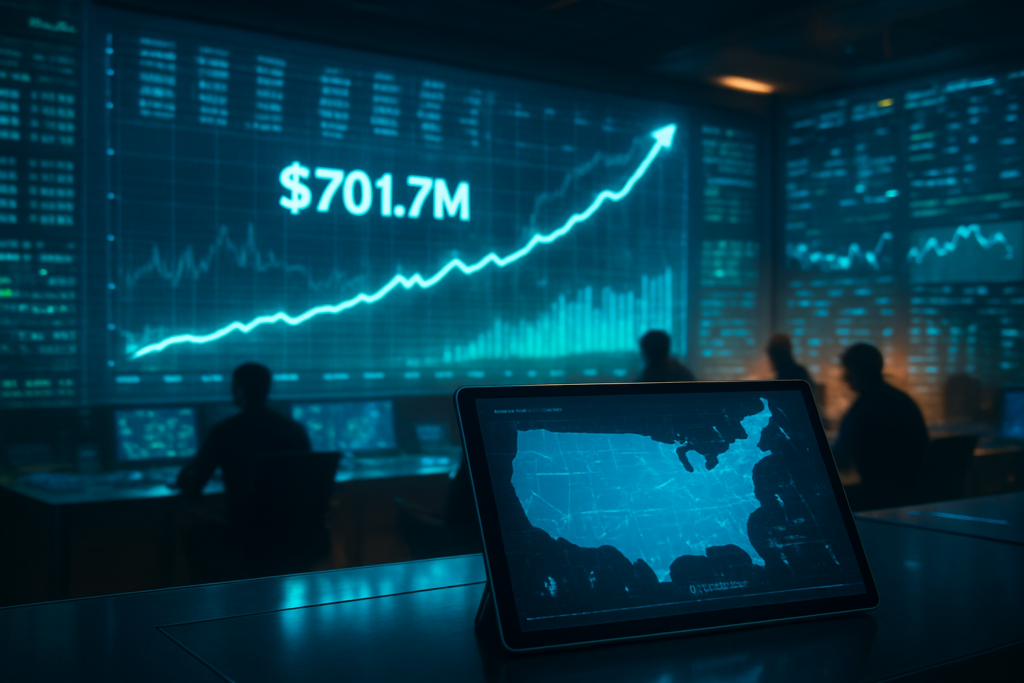
On January 12, 2026, the prediction market industry reached a historic milestone, processing a staggering $701.7 million in a single 24-hour trading session. This unprecedented volume represents a watershed moment for the sector, effectively transitioning event-based contracts from a niche curiosity into a primary "truth engine" for institutional and retail investors alike. The surge was fueled by a volatile combination of macroeconomic uncertainty, high-stakes political maneuvering, and a geopolitical shock in South America, proving that markets can price real-world outcomes with more agility than traditional polling or economic forecasting.
Leading the charge was Kalshi, which commanded a dominant 66.4% of the market share, facilitating over $465.9 million in trades. The record-breaking day was not merely a fluke of liquidity but the result of a "perfect storm" of events: a high-stakes standoff between the Department of Justice and the Federal Reserve, an aggressive early-cycle positioning for the 2026 U.S. Midterm Elections, and the sudden capture of Venezuelan President Nicolás Maduro. As traders recalibrated their portfolios in real-time, the day's activity cemented prediction markets as the go-to destination for hedging against systemic risk.
The Market: What's Being Predicted
The bulk of the day's record volume was concentrated on high-impact economic and political outcomes. On Kalshi, the regulated leader in the U.S. market, the most liquid contracts centered on Federal Reserve policy and the 2026 Midterm Election landscape. Specifically, traders were obsessively pricing the odds of a March 2026 interest rate cut, which fluctuated wildly throughout the day, peaking at a 74% probability. This was complemented by the platform's "Combos" feature, which allowed users to bet on multi-layered outcomes—such as the simultaneous occurrence of a "sticky" CPI print and a specific Fed reaction—generating over $100 million in positioning alone.
While Kalshi dominated the U.S. domestic scene, Polymarket and Opinion Labs each processed approximately $100 million in volume, focusing on global geopolitical stability. Polymarket’s liquidity was driven by its "Operation Iron Strike" contracts regarding Middle Eastern military outcomes and the immediate aftermath of the capture of Nicolás Maduro. This event created a massive liquidity vacuum, with one savvy trader reportedly turning a $30,000 bet into a $400,000 windfall in just hours. These markets are no longer just binary "yes/no" propositions; they have evolved into complex instruments with deep liquidity, often resolving within hours of major news breaks.
Why Traders Are Betting
The record volume was catalyzed by a breakdown in traditional institutional trust and a series of high-stakes domestic developments. Tensions between the U.S. Department of Justice (DOJ) and Federal Reserve Chair Jerome Powell reached a boiling point on January 12. Reports surfaced that the DOJ had issued grand jury subpoenas to Powell regarding renovations at the Fed’s headquarters, a move interpreted by many as an assault on the central bank’s independence. This constitutional friction sent traders to prediction markets to hedge against a potential leadership crisis at the Fed, driving massive volume into "Fed Chair Stability" and "Interest Rate" contracts.
Further driving the frenzy was a tactical move by the executive branch. President Trump’s directive for Fannie Mae and Freddie Mac to purchase $200 billion in mortgage bonds was seen as a direct attempt to stimulate the housing market outside the purview of the Federal Reserve. This "fiscal-monetary decoupling" led to intense positioning on the January 13 CPI (Inflation) release. Simultaneously, the 2026 Midterms moved into the spotlight as institutional traders began placing heavy bets on a "Split Congress" outcome. Current odds on Kalshi suggest a 66–68% probability that Republicans will retain control of the Senate, while the House remains a toss-up, forcing hedge funds to use these markets to price in future legislative gridlock.
Broader Context and Implications
The January 12 record is a testament to the successful integration of prediction markets into the broader financial ecosystem. A significant portion of Kalshi’s volume was facilitated through its deep integration with Robinhood Markets (NASDAQ: HOOD), which gave over 24 million retail traders direct access to event contracts through its "Prediction Markets Hub." This democratization of access has allowed retail sentiment to collide with institutional hedging, creating a more robust and accurate pricing mechanism. Additionally, the Intercontinental Exchange (NYSE: ICE) has fueled the sector's growth by providing a $2 billion liquidity injection into platforms like Polymarket, signaling that the traditional financial establishment now views these markets as a legitimate asset class.
Historically, prediction markets have often been more accurate than pundits or polls. A Vanderbilt University study released on the same day noted that PredictIt—despite its regulatory size limits—maintained a 93% accuracy rate on political outcomes compared to traditional forecasting. This "wisdom of the crowd" effect is now being scaled to hundreds of millions of dollars. As these platforms grow, they are also facing increased regulatory scrutiny, yet their ability to provide real-time, incentivized data makes them indispensable for policy makers and investors trying to navigate an increasingly unpredictable global landscape.
What to Watch Next
The immediate focus for traders is the fallout from the January 13 CPI release and the escalating legal drama surrounding the Federal Reserve. If the CPI print comes in higher than the anticipated 2.7%, expect the probability of a March rate cut to plummet, potentially triggering another high-volume day as traders unwind their positions. Furthermore, the capture of Maduro has opened up a vacuum in South American political markets, with new contracts already appearing on the future of Venezuelan governance and oil production quotas.
In the political arena, the 2026 Midterm markets are just beginning to heat up. Watch for the first major primary challenges in late Q1 2026, which will likely shift the "Split Congress" odds. As more public companies begin to report Q4 2025 earnings in the coming weeks, we may also see a surge in "Earnings Triple-Play" contracts, where traders bet on a company’s revenue, EPS, and guidance simultaneously.
Bottom Line
The $701.7 million trading day on January 12, 2026, marks the end of the experimental phase for prediction markets. With Kalshi’s $466 million performance proving the viability of regulated U.S. exchanges and Polymarket’s dominance in global geopolitics, the industry has reached a level of maturity that demands the attention of every serious investor. These markets are no longer just for "betting" on the news; they are becoming the news themselves, providing the most accurate, real-time data available on everything from inflation to international coups.
As the intersection of finance, politics, and technology continues to blur, prediction markets will likely become the primary venue for price discovery in the 21st century. The ability to hedge against a constitutional crisis or a missed jobs report with the click of a button—aided by giants like Robinhood Markets (NASDAQ: HOOD)—has changed the rules of the game. For those watching the numbers, January 12 was not just a record day; it was a glimpse into the future of global markets.
This article is for informational purposes only and does not constitute financial or betting advice. Prediction market participation may be subject to legal restrictions in your jurisdiction.
PredictStreet focuses on covering the latest developments in prediction markets.
Visit the PredictStreet website at https://www.predictstreet.ai/.