Biopharma manufacturing company Repligen Corporation (NASDAQ: RGEN) reported revenue ahead of Wall Street’s expectations in Q3 2026, with revenue up 10.9% year on year to $209.3 million. The company’s full-year revenue guidance of $848 million at the midpoint came in 1.4% above analysts’ consensus estimates. Its non-GAAP profit of $0.53 per share was 14.6% above analysts’ consensus estimates.
For more on Repligen, read our free full research report.
Repligen (RGEN) Q3 2026 highlights:
- Revenue $209.3 million vs S&P analysts’ consensus estimates of $207 million (10.9% year-on-year growth, 1.1% beat)
- Adjusted EPS $0.53 vs S&P analysts’ consensus estimates of $0.46 (14.6% beat)
- Adjusted EBITDA $43.84 million vs analysts’ consensus estimates of $38.77 million (20.9% margin, 13.1% beat)
- Revenue guidance The company lifted its revenue guidance for the full year to $848 million at the midpoint from $824 million, a 2.9% increase
- Adjusted EPS guidance Management slightly raised its full-year adjusted EPS guidance to $2.07 at the midpoint
- Operating margin -14.1%, down from 8.9% in the same quarter last year
- Free cash flow margin 18.1%, down from 23% in the same quarter last year
- Organic revenue rose 12.5% year on year (beat)
- Market capitalization $10.17 billion
Olivier Loeillot, president and chief executive officer of Repligen, said, “We delivered a record third quarter, with $209 million in revenue and 12.5% organic growth, driven by continued strength across our diversified portfolio. End-market demand continues to improve, with healthy trends in consumables and services complemented by a growing capital equipment order book.”
Revenue growth
Examining a company’s long-term performance can provide clues about its quality. Any business can experience short-term success, but top-performing ones sustain growth for years. Repligen’s revenue grew at a mediocre 6.3% compounded annual growth rate over the last five years, falling short of the healthcare sector benchmark.
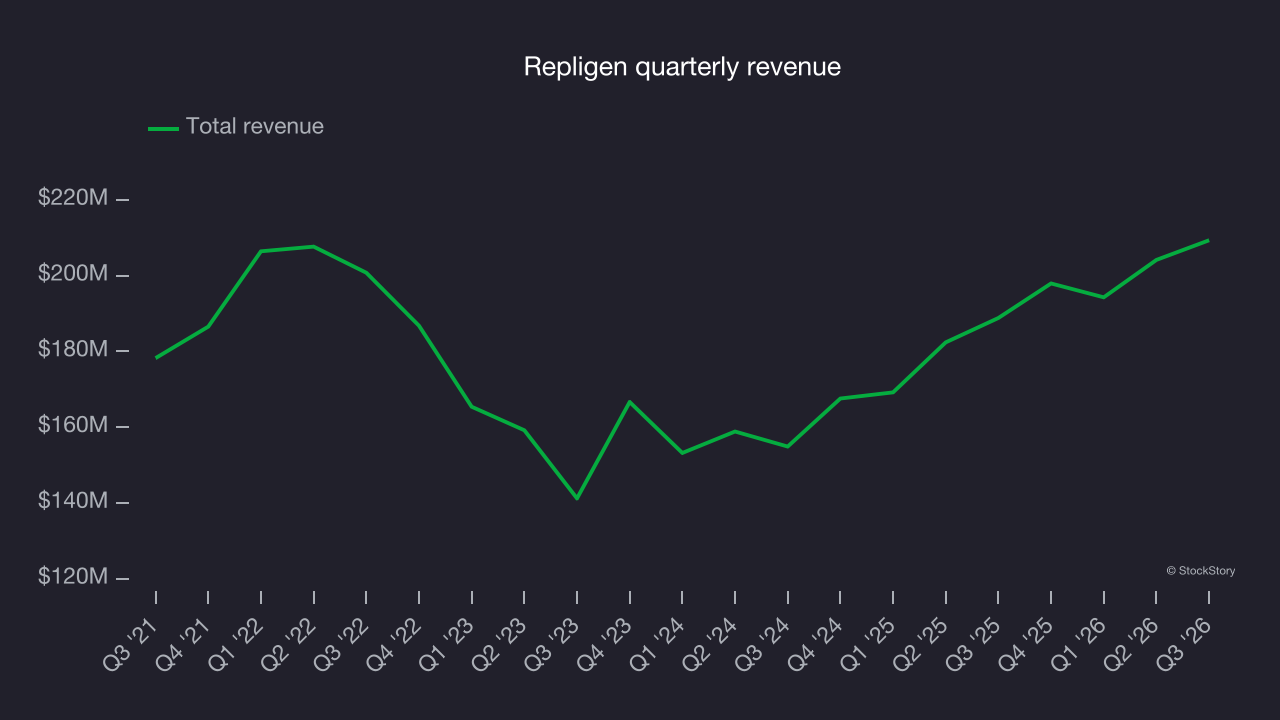
Long-term growth is the most important, but within healthcare, a half-decade historical view may miss new innovations or demand cycles. Repligen’s annualized revenue growth of 12.8% over the last two years is above its five-year trend, suggesting its demand recently accelerated. 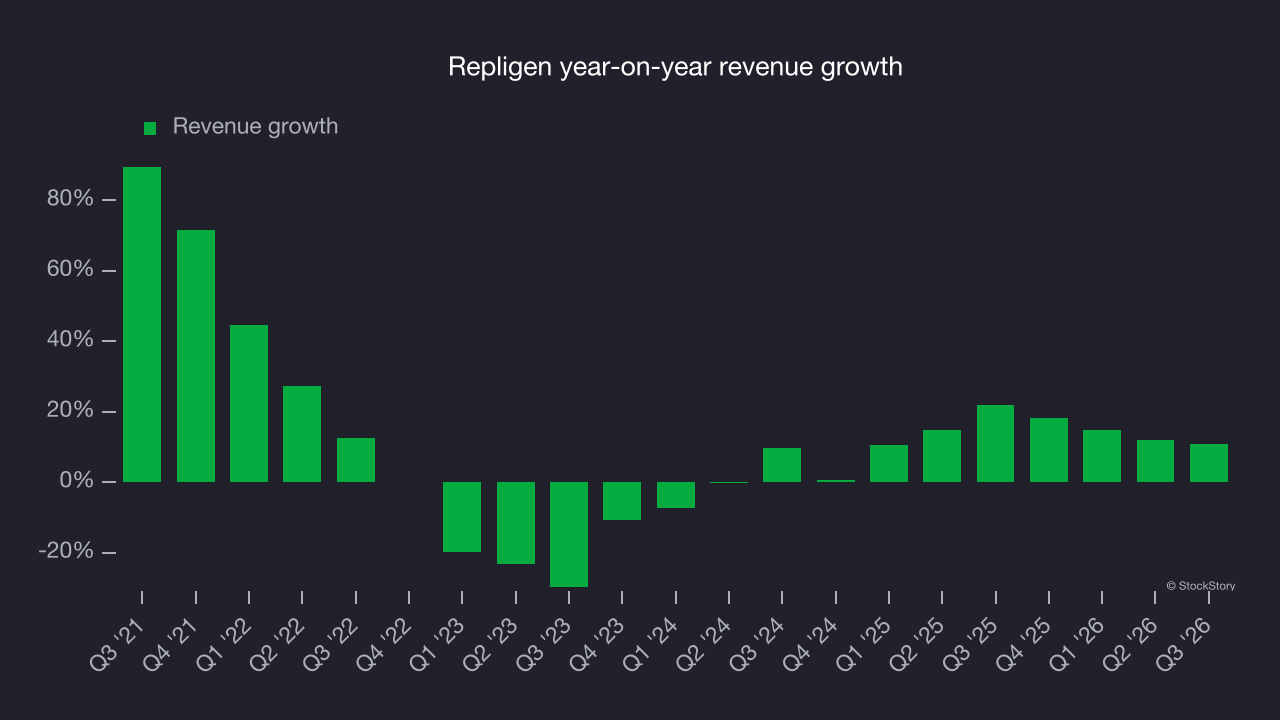
Organic revenue helps clarify the company’s revenue dynamics by stripping out one-time events like acquisitions and currency fluctuations that don’t accurately reflect its fundamentals. Over the last two years, Repligen’s organic revenue averaged 12.8% year-on-year growth. This was in line with its two-year revenue growth, indicating that core operations, rather than acquisitions and divestitures, drove most of its results. 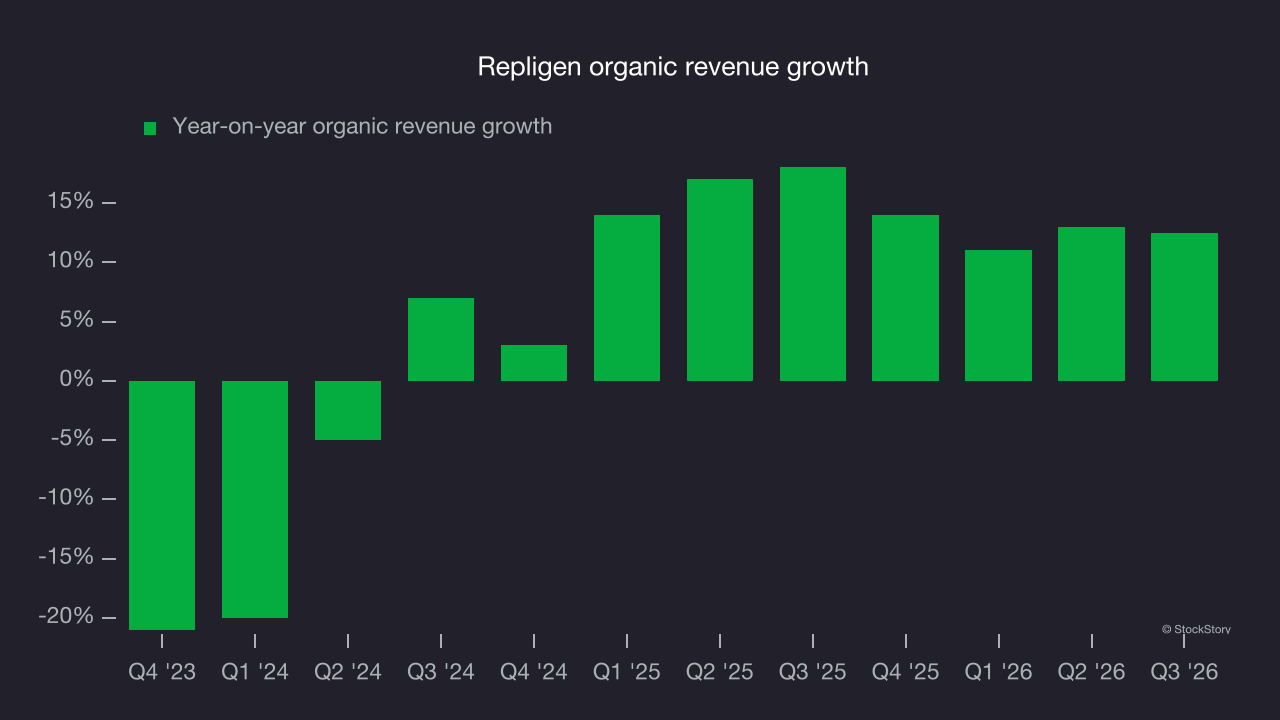
This quarter, Repligen reported year-on-year revenue growth of 10.9%, and its $209.3 million of revenue exceeded Wall Street’s consensus estimates by 1.1%.
Looking ahead, sell-side analysts expect revenue to grow 16.7% over the next 12 months, according to S&P, an improvement versus the last two years. This strong projection indicates its newer products and services will spur better revenue performance.
Adjusted operating margin
Repligen has managed its cost base well over the last five years. It demonstrated solid profitability for a healthcare business, producing an average adjusted operating margin of 18.2%.
Looking at the trend in its profitability, Repligen’s adjusted operating margin decreased by 15.1 percentage points over the last five years, but it rose by 2.1 percentage points on a two-year basis. Still, shareholders will want to see Repligen become more profitable in the future.
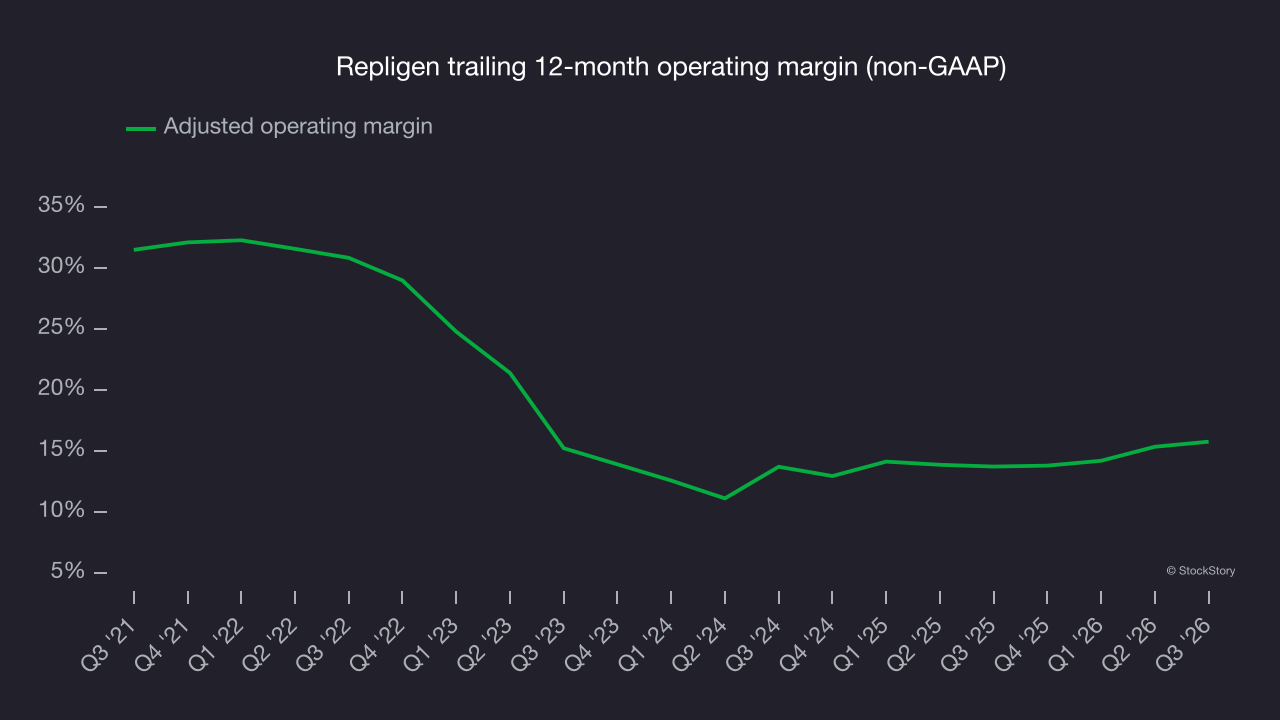
In Q3, Repligen generated an adjusted operating margin of 15.9%, up 1.7 percentage points year on year. This improvement shows it was more efficient.
Earnings per share
Revenue trends explain a company’s historical growth, but the long-term change in earnings per share (EPS) points to the profitability of that growth. For example, a company could inflate its revenue through excessive spending on advertising and promotions.
Repligen’s EPS declined by 5.9% annually over the last five years while its revenue grew by 6.3%. This indicates the company became less profitable on a per-share basis as it expanded due to non-fundamental factors such as interest expenses and taxes.
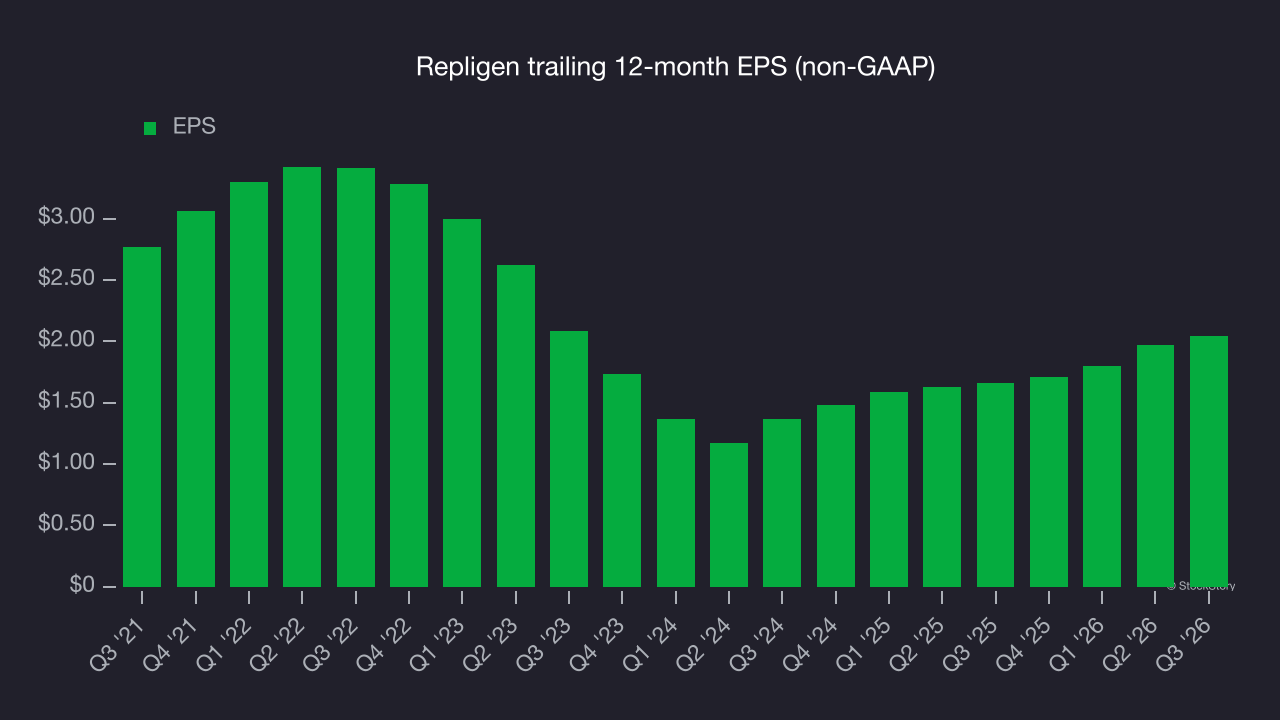
A closer look at Repligen’s earnings helps explain its performance. As noted earlier, Repligen’s adjusted operating margin expanded this quarter but declined by 15.1 percentage points over the last five years. This was the most relevant factor (aside from the revenue impact) behind its lower earnings; interest expenses and taxes can also affect EPS but don’t tell us as much about a company’s fundamentals.
In Q3, Repligen reported adjusted EPS of $0.53, up from $0.46 in the same quarter last year. This was well above analysts’ consensus estimates, a positive result for shareholders. Over the next 12 months, Wall Street expects Repligen’s full-year EPS to grow 20.8% from $2.04 to $2.46, according to S&P.
Key takeaways from Repligen’s Q3 results
Repligen paired EPS above analysts’ consensus estimates with full-year revenue guidance slightly ahead of Wall Street’s consensus, making this a solid quarter with clear positives. Investors were likely hoping for more, as shares tumbled 5% to $171.24 immediately after the results.
When evaluating Repligen as an investment, what happened in the latest quarter matters, but not as much as longer-term business quality and valuation. For more on these factors, read our full research report here (it’s free).