The end of the earnings season is always a good time to take a step back and see who shined (and who didn’t). Let’s take a look at how senior health, home health & hospice stocks fared in Q2, starting with The Pennant Group (NASDAQ: PNTG).
The senior health, home care, and hospice care industries provide essential services to aging populations and patients with chronic or terminal conditions. These companies benefit from stable, recurring revenue driven by relationships with patients and families that can extend many months or even years. However, the labor-intensive nature of the business makes it vulnerable to rising labor costs and staffing shortages, while profitability is constrained by reimbursement rates from Medicare, Medicaid, and private insurers. Looking ahead, the industry is positioned for tailwinds from an aging population, increasing chronic disease prevalence, and a growing preference for personalized in-home care. Advancements in remote monitoring and telehealth are expected to enhance efficiency and care delivery. However, headwinds such as labor shortages, wage inflation, and regulatory uncertainty around reimbursement could pose challenges. Investments in digitization and technology-driven care will be critical for long-term success.
The 7 senior health, home health & hospice stocks we track reported a mixed Q2. As a group, revenues missed analysts’ consensus estimates by 0.5%.
Amidst this news, share prices of the companies have had a rough stretch. On average, they are down 8.4% since the latest earnings results.
The Pennant Group (NASDAQ: PNTG)
Spun off from The Ensign Group in 2019 to focus on non-skilled nursing healthcare services, Pennant Group (NASDAQ: PNTG) operates home health, hospice, and senior living facilities across 13 western and midwestern states, serving patients of all ages including seniors.
The Pennant Group reported revenues of $295.8 million, up 36.3% year on year. This print exceeded analysts’ expectations by 2.5%. Overall, it was a very strong quarter for the company with full-year revenue guidance slightly topping analysts’ expectations and a beat of analysts’ EPS estimates.
“Pennant delivered another strong quarter, putting us on pace to exceed the top end of our original full year guidance,” said Brent Guerisoli, the Company’s Chief Executive Officer.
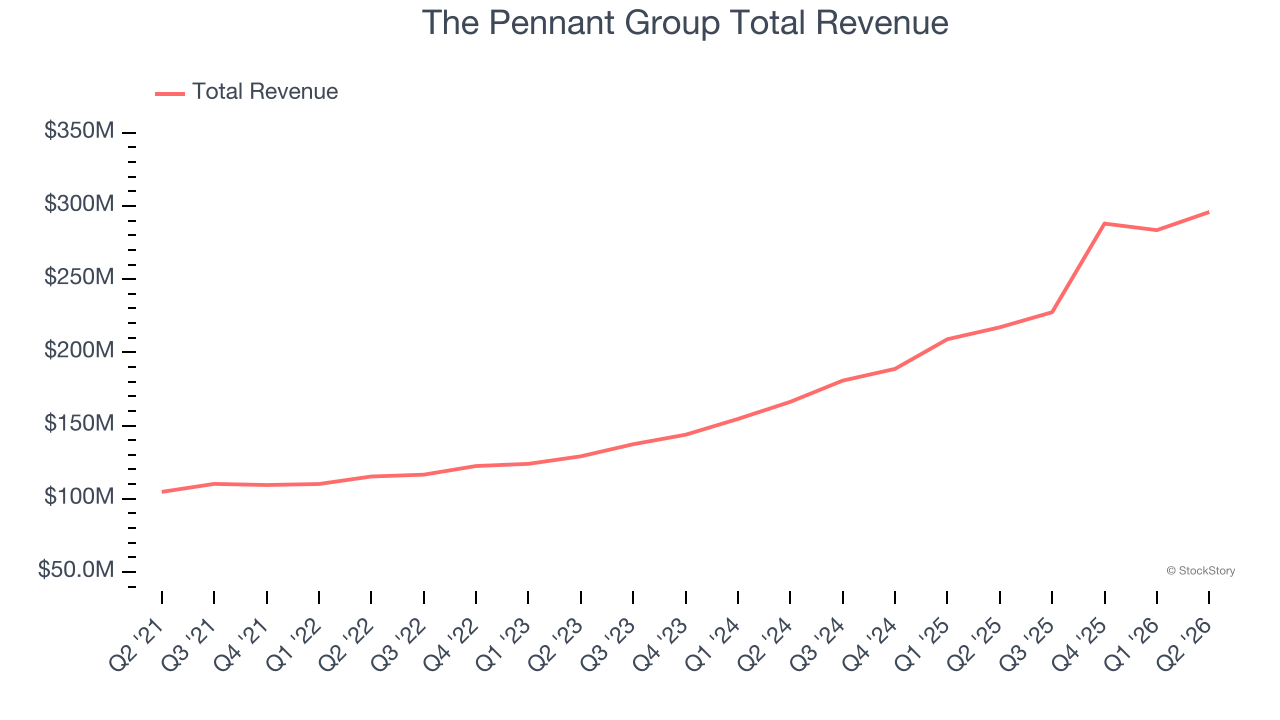
The Pennant Group pulled off the fastest revenue growth and highest full-year guidance raise among its peers. The results were likely priced in, however, and the stock is flat since reporting. It currently trades at $38.49.
Is now the time to buy The Pennant Group? Access our full analysis of the earnings results here, it’s free.
Best Q2: BrightSpring Health Services (NASDAQ: BTSG)
Founded in 1974, BrightSpring Health Services (NASDAQ: BTSG) offers home health care, hospice, neuro-rehabilitation, and pharmacy services.
BrightSpring Health Services reported revenues of $3.87 billion, up 23% year on year, outperforming analysts’ expectations by 5.9%. The business had a very strong quarter with a beat of analysts’ EPS estimates and full-year revenue guidance slightly topping analysts’ expectations.
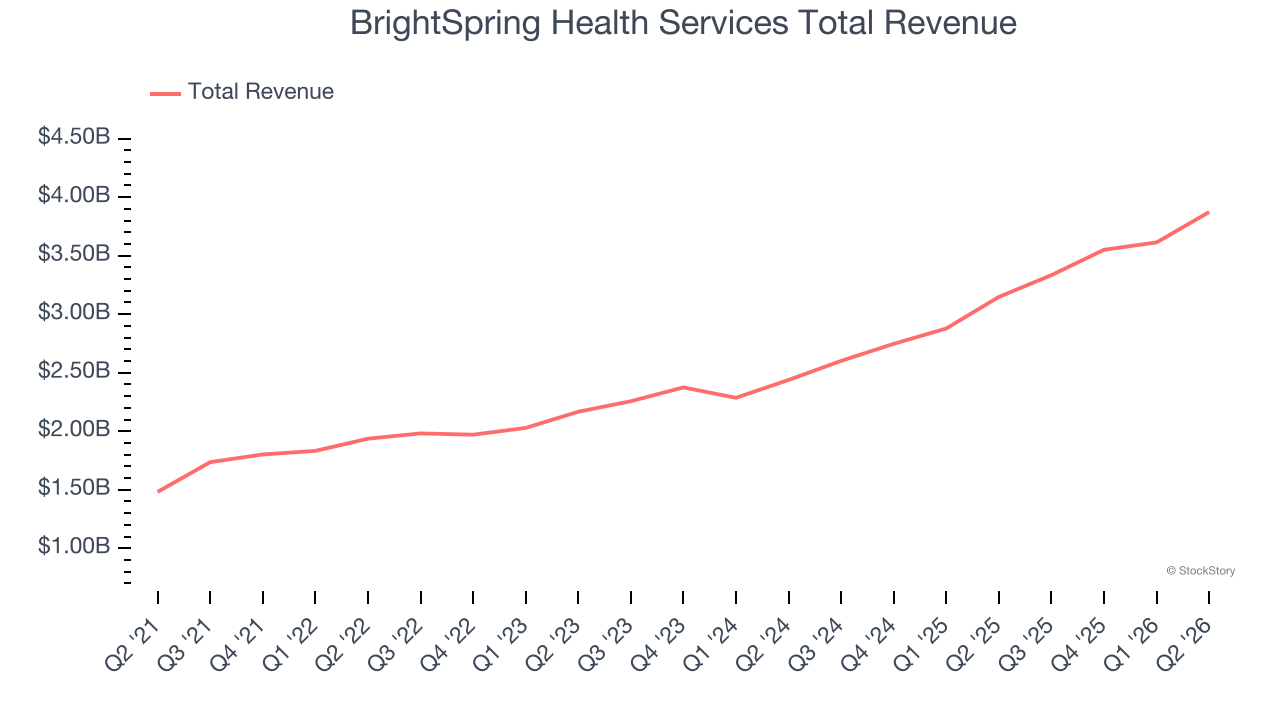
BrightSpring Health Services delivered the biggest analyst estimate beat of the whole group. Although it had a fine quarter compared to its peers, the market seems unhappy with the results as the stock is down 16.3% since reporting. It currently trades at $61.00.
Is now the time to buy BrightSpring Health Services? Access our full analysis of the earnings results here, it’s free.
Weakest Q2: AdaptHealth (NASDAQ: AHCO)
With a network of approximately 680 locations serving patients across all 50 states, AdaptHealth (NASDAQ: AHCO) provides home medical equipment, supplies, and related services to patients with chronic conditions like sleep apnea, diabetes, and respiratory disorders.
AdaptHealth reported revenues of $740.3 million, up 12.7% year on year, falling short of analysts’ expectations by 12.6%. It was a disappointing quarter as it posted full-year revenue and EBITDA guidance missing analysts’ expectations.
AdaptHealth delivered the weakest performance against analyst estimates and weakest full-year guidance update in the group. As expected, the stock is down 42.4% since the results and currently trades at $6.24.
Read our full analysis of AdaptHealth’s results here.
Addus HomeCare (NASDAQ: ADUS)
Serving approximately 66,000 clients across 22 states with a focus on "dual eligible" Medicare and Medicaid beneficiaries, Addus HomeCare (NASDAQ: ADUS) provides in-home personal care, hospice, and home health services to elderly, chronically ill, and disabled individuals.
Addus HomeCare reported revenues of $377.4 million, up 8% year on year. This print was in line with analysts’ expectations. However, it was a mixed quarter as it underperformed in some other aspects of the business.
The stock is up 1.6% since reporting and currently trades at $118.63.
Read our full, actionable report on Addus HomeCare here, it’s free.
Brookdale (NYSE: BKD)
With a network of over 650 communities serving approximately 59,000 residents across 41 states, Brookdale Senior Living (NYSE: BKD) operates senior living communities across the United States, offering independent living, assisted living, memory care, and continuing care retirement communities.
Brookdale reported revenues of $718.6 million, down 11.6% year on year. This number came in 2.3% below analysts’ expectations. More broadly, it was a mixed quarter as it also produced a beat of analysts’ EPS estimates but full-year EBITDA guidance meeting analysts’ expectations.
Brookdale had the slowest revenue growth among its peers. The stock is down 10.6% since reporting and currently trades at $12.24.
Read our full, actionable report on Brookdale here, it’s free.
Market Update
Over the past year, investors have been forced to repeatedly answer the same question: what is the market’s biggest risk? The answer has changed several times, and each shift has reshaped market leadership.
Late in 2025 and early 2026, artificial intelligence became the market’s primary uncertainty. Investors questioned whether AI would erode software pricing power and weaken competitive moats as AI made it easier to replicate once-differentiated products.
By the spring, technology took a back seat to geopolitics. The U.S. conflict with Iran briefly became the market’s dominant narrative, raising concerns about oil prices, inflation, and global growth. But as energy markets remained orderly and fears of a prolonged supply disruption faded, investors quickly turned their focus back to fundamentals.
Want to invest in winners with rock-solid fundamentals? Check out our Hidden Gem Stocks and add them to your watchlist. These companies are poised for growth regardless of the political or macroeconomic climate.