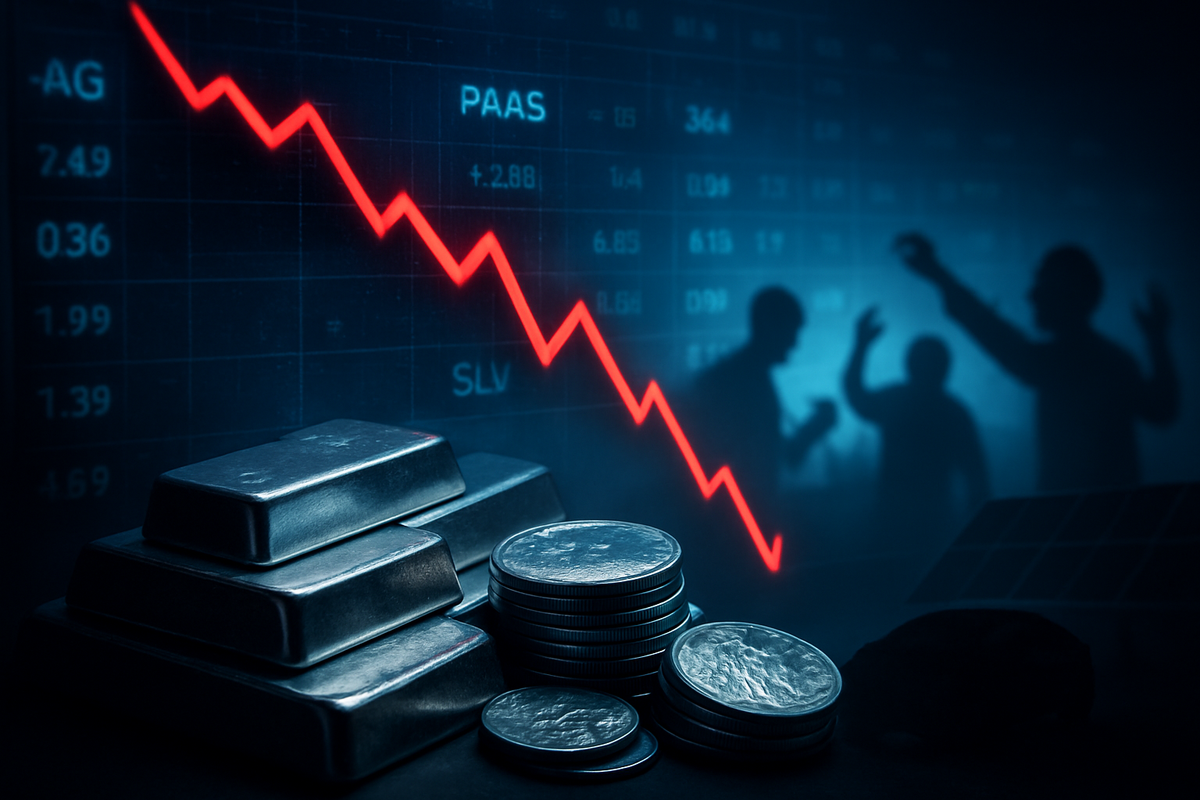
The silver market, which spent much of 2025 in a parabolic ascent that captured the world’s attention, has hit a violent wall in the final days of the year. After touching a historic nominal high of $85.87 per ounce on December 29, the white metal has plummeted more than 17% in a frantic 72-hour "flash crash," closing the year at approximately $71.35 per ounce. This sudden retreat has sent shockwaves through the commodities complex, leaving investors to wonder if the "silver squeeze" has finally run out of steam or if this is merely a tactical reset before an even more volatile 2026.
The immediate implications of this dive are profound. For a metal that has gained over 140% year-to-date, the sudden drawdown on December 31 has triggered billions in margin calls and forced a massive deleveraging among retail and institutional traders alike. While the long-term structural deficit remains a central pillar of the silver bull case, the year-end carnage serves as a stark reminder of the metal’s notorious reputation as "the devil’s copper"—a market where liquidity can vanish in an instant, leaving latecomers to bear the brunt of the volatility.
The Perfect Storm: A Timeline of the Year-End Retreat
The collapse began in earnest on the morning of December 29, 2025, just as silver appeared poised to break the $90 threshold. The primary catalyst was a decisive intervention by the CME Group, which hiked initial margin requirements for silver futures twice in a single week, eventually reaching a staggering $25,000 per contract. This move was designed to cool a market that many regulators viewed as dangerously overheated, but it instead triggered a cascade of forced liquidations. By the time the closing bell rang on Monday, silver had shed 7% of its value in one of its most volatile sessions in history.
Compounding the technical pressure was a shift in the macroeconomic narrative. On December 30, leaked minutes from the Federal Reserve's final meeting of the year suggested a "hawkish cut" stance; while rates were lowered to a range of 3.5%–3.75%, the committee signaled that the easing cycle for 2026 would be significantly slower than the market had priced in. This revelation, combined with a sudden strengthening of the US Dollar and 10-year Treasury yields climbing to 4.12%, removed the "easy money" floor that had supported precious metals throughout the autumn.
The final blow came on New Year’s Eve, as thin holiday liquidity amplified a wave of profit-taking. Reports of significant progress in geopolitical de-escalation between Russia and Ukraine—rumored to be 95% complete under the mediation of the Trump administration—sapped the safe-haven premium from the market. By the afternoon of December 31, the Silver Trust ETF (NYSE: SLV) was trading down over 6%, as investors scrambled to lock in annual gains before the books closed on a historic, albeit chaotic, year for the metal.
Industrial Squeeze: Winners and Losers in the Silver Fallout
The silver dive has created a stark divide between the companies that pull the metal from the ground and those that rely on it for the "green energy" transition. Mining giants, which had enjoyed record-breaking margins for most of 2025, saw their share prices hammered in the year-end rout. First Majestic Silver (NYSE: AG) and Pan American Silver (NYSE: PAAS) both saw sharp declines on December 31, falling 4.13% and 5.80% respectively, as the "leverage" they provide to the silver price worked against them in the downturn. Even industry leaders like Wheaton Precious Metals (NYSE: WPM), which hit an all-time high of $124.22 just days earlier, were not immune, retreating as institutional funds rebalanced their portfolios.
Conversely, the price drop has provided a momentary sigh of relief for industrial users who have been battling "greenflation." Tesla (NASDAQ: TSLA) has faced mounting production costs in 2025, with silver—essential for EV power electronics and battery systems—adding hundreds of dollars to the bill of materials for each vehicle. Similarly, JinkoSolar (NYSE: JKS) saw its module margins crater earlier in the year as silver paste costs jumped from 5% to over 14% of total expenses. For these companies, the year-end dive is a welcome reprieve, though one that may be short-lived given the looming supply constraints of 2026.
The standout winner in this environment has been First Solar (NASDAQ: FSLR). Unlike its silicon-based competitors, First Solar’s thin-film technology requires roughly 98% less silver per watt. As silver prices skyrocketed in late 2025, First Solar’s stock rose 14% as it successfully marketed its cost-advantage over competitors like JinkoSolar. The year-end price dive has done little to diminish this advantage, as the company remains the primary hedge for investors who want exposure to solar growth without the volatility of the silver market.
The AI Supercycle and the "Critical Mineral" Shift
Beyond the immediate price action, the late-2025 silver dive must be viewed through the lens of a shifting global economy. Silver's market capitalization briefly surpassed that of Nvidia (NASDAQ: NVDA) on December 28, a symbolic moment that highlighted the metal's role as a critical component in the AI revolution. Silver is indispensable for the high-performance semiconductor packaging and data center infrastructure that powers Nvidia’s Blackwell and upcoming Rubin architectures. As Nvidia reported that its chips are sold out through mid-2026, the structural demand for silver has shifted from a "precious luxury" to an "industrial necessity."
This transition was codified in late 2025 when the US government officially designated silver as a "Critical Mineral." This policy shift, aimed at securing domestic supply chains for defense and green energy, mirrors the geopolitical tension surrounding the metal. On January 1, 2026, China—which controls a vast majority of the world's refined silver—is set to implement strict new export restrictions. Only a handful of state-approved firms will be allowed to ship silver abroad, a move that many analysts believe will lead to a massive supply shock in the first quarter of 2026.
Historically, such "flash crashes" in silver often precede even larger moves to the upside once the market digests the excess leverage. The 2025 year-end dive bears a striking resemblance to the volatility seen in 1979-1980, though today’s drivers are industrial rather than purely speculative. With a projected 230 million ounce deficit for 2025 and no major new mines scheduled to come online in the near term, the "wider significance" of this dive is likely a consolidation phase before the market attempts to price in the true scarcity of the metal.
Looking Ahead: The 2026 Supply Cliff
As the market moves into 2026, the primary question is whether the "dive" of late 2025 was a peak or a pit stop. In the short term, the market will likely remain choppy as it adjusts to the new CME margin requirements and the implementation of China's export bans. Investors should expect a period of "physical-paper divergence," where the price of physical silver in London and Shanghai begins to command a significant premium over the COMEX futures price as inventories in registered vaults continue to dwindle.
The long-term outlook remains dominated by the "silver gap." With the solar sector now consuming nearly 20% of global supply and the AI infrastructure build-out only in its early innings, the demand side of the equation is inelastic. Analysts at major investment banks are already revising their 2026 targets, with some suggesting that silver could test the $100 per ounce mark if the China export restrictions create the anticipated bottleneck. For mining companies, the challenge will be managing the extreme volatility while attempting to bring dormant projects online to meet this unprecedented demand.
Navigating the New Commodity Reality
The year-end dive of 2025 is a definitive chapter in the ongoing transformation of the silver market. What was once viewed primarily as a monetary asset or a "poor man’s gold" has evolved into a strategic industrial commodity that sits at the intersection of AI, renewable energy, and geopolitical competition. The 17% drop from the December 29 peak has flushed out weak hands and reset the technical indicators, but it has done nothing to resolve the underlying supply-demand imbalance that defined the year.
As we enter 2026, the market is no longer just watching the Federal Reserve or the US Dollar; it is watching the production lines of Tesla, the data centers of Nvidia, and the export docks of Shanghai. Investors should remain cautious of the metal's inherent volatility but keep a close eye on physical inventory levels and the "Critical Mineral" policy implementation in the US. The "silver dive" of 2025 may eventually be remembered not as the end of a bubble, but as the last opportunity for the market to breathe before the supply cliff of 2026 takes hold.
This content is intended for informational purposes only and is not financial advice.