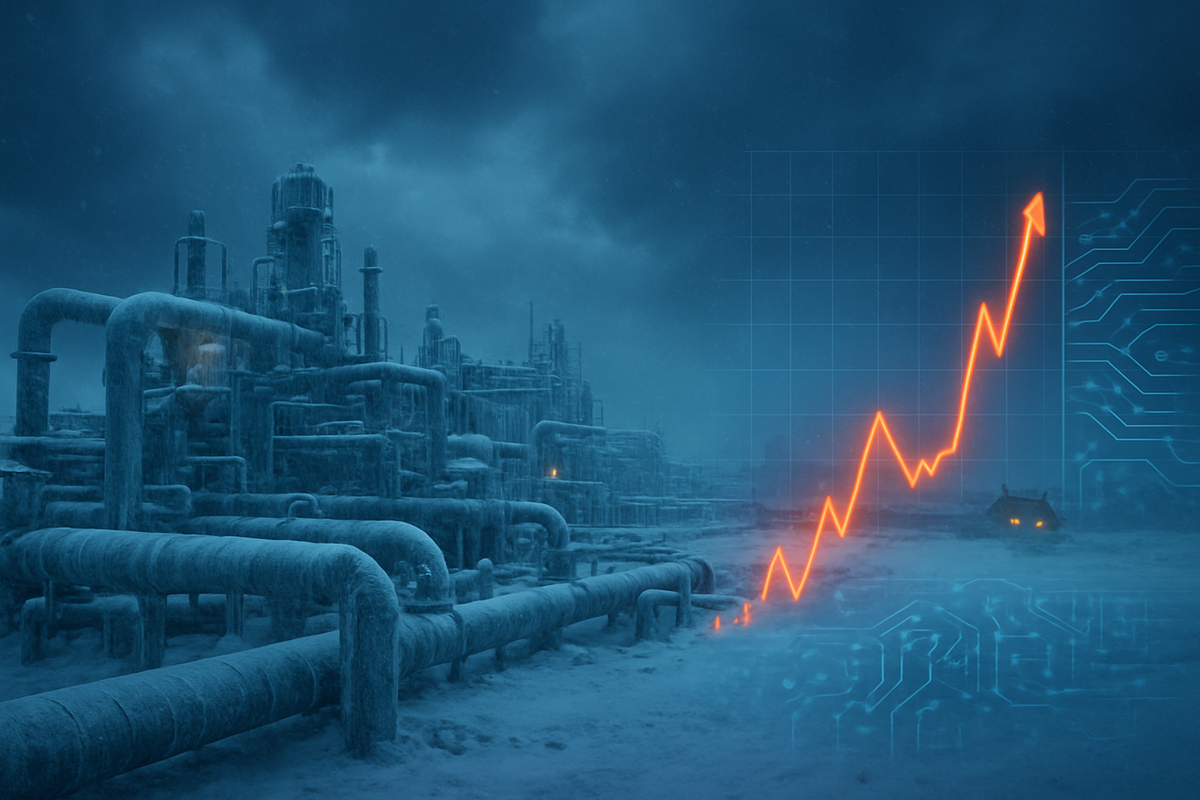
The United States energy market has been plunged into a state of volatile transition as "Winter Storm Fern," a catastrophic Arctic deep freeze, swept across the nation in late January 2026. This extreme weather event has sent natural gas prices into a parabolic ascent, with the Henry Hub benchmark futures climbing more than 50% in a matter of days. As of January 26, 2026, the benchmark price for February delivery has surpassed $6.20 per million British thermal units (MMBtu), up from a stable $3.10 just a week prior.
The immediate implications are severe: an estimated 11 to 20.4 billion cubic feet per day (Bcf/d) of production—nearly 15% of total U.S. output—has been knocked offline due to "freeze-offs," where liquid in the gas stream solidifies and blocks pipeline flow. This supply contraction, coupled with record-shattering demand from residential heating and the burgeoning electricity requirements of AI data centers, has pushed the U.S. energy grid to its breaking point and left consumers bracing for heating bills that could double or triple in the coming month.
The $58 Spot Price
The crisis began to take shape in mid-January when a massive polar vortex fractured, sending sub-zero temperatures as far south as the Texas Gulf Coast. By January 20, 2026, the impact on natural gas infrastructure was immediate. In basins like the Permian and Haynesville, which are typically less winterized than northern fields, wellhead temperatures dropped below the threshold for safe operation. This triggered widespread freeze-offs, a phenomenon that effectively "choked" the nation's gas supply exactly when it was needed most.
The timeline of the surge was rapid. On January 18, natural gas was trading quietly near $3.00/MMBtu. By January 22, as the first reports of 8 Bcf/d in production losses hit the wires, prices breached $4.50. By today, January 26, the benchmark reached a peak of $6.28. In the spot market—where gas is bought for immediate delivery—the volatility was even more pronounced. Regional hubs in the Northeast, such as the Transco Zone 6, reported trades as high as $58/MMBtu, while the Houston Ship Channel saw prices touch $30/MMBtu.
Key players, including the Department of Energy (DOE) and grid operators like the PJM Interconnection and ERCOT, were forced into emergency footing. For the first time in 2026, the DOE issued federal 202(c) emergency orders, allowing power plants to bypass certain environmental emissions limits to ensure that all available generation—regardless of fuel type—could be pushed onto the grid to prevent a catastrophic collapse similar to the 2021 Texas blackout.
Market Winners and Losers: The Corporate Fallout
The sudden price spike has created a stark divide between energy producers and utility providers. EQT Corporation (NYSE: EQT), the largest independent natural gas producer in the United States, has emerged as a primary beneficiary. With a significant portion of its winter production unhedged, EQT is positioned to capture massive free cash flow from the current price environment. Similarly, the recently rebranded Expand Energy (NASDAQ: EXE)—the entity formed by the merger of Chesapeake Energy and Southwestern Energy—saw its stock surge as analysts projected a 40% jump in 2026 earnings per share following the storm's peak.
Midstream giants like Kinder Morgan (NYSE: KMI) have also seen record-setting performance. The company’s sprawling pipeline network saw an all-time high throughput of nearly 50 Bcf/d as it moved critical supplies to heating-starved regions, driving its EBITDA to record levels for the first quarter. In the export sector, Cheniere Energy (NYSE: LNG) faced a more complex landscape. While it remains a dominant force, the narrow spread between surging domestic prices and European benchmarks (TTF) has temporarily squeezed arbitrage profits for its spot-market trading arm, though its long-term fortress-like contracts remain intact.
On the losing side of the ledger, regulated utilities like Duke Energy (NYSE: DUK) and NextEra Energy (NYSE: NEE) are facing significant operational and financial strain. While these companies often have "fuel adjustment clauses" to pass costs to consumers, the sheer scale of the $1.1 billion-plus in additional fuel costs incurred during the freeze is expected to trigger intense regulatory scrutiny and immediate rate hike requests. Duke Energy has already warned that residential customers could see "storm recovery surcharges" appearing on bills as early as February 2026.
The AI Factor and a Shifting Regulatory Landscape
This 2026 freeze is fundamentally different from historical precedents like Winter Storm Uri (2021) or Winter Storm Elliott (2022). While those events were primarily driven by residential heating demand, the current crisis is exacerbated by the "inelastic" demand from AI data centers. In regions like PJM's "Data Center Alley" in Northern Virginia, the power load from massive computing clusters cannot be easily curtailed, creating a high floor for electricity demand that competed directly with residential gas needs.
This shift has highlighted a growing fragility in the U.S. energy storage system. Entering January 2026, natural gas storage levels were approximately 1% below five-year norms, leaving no margin for error. The resulting price spike has reignited a fierce debate over "energy security" versus "energy transition." Proponents of expanded gas infrastructure argue that the freeze-offs prove the need for more hardened pipelines and storage facilities, while critics point to the grid's reliance on a single, volatile commodity as a systemic risk.
Regulators at the Federal Energy Regulatory Commission (FERC) are already signaling that a new round of mandatory winterization standards for gas producers—not just power plants—may be forthcoming. The proactive use of 202(c) orders by the DOE suggests a new "emergency-first" doctrine in Washington, prioritizing reliability over environmental constraints during extreme weather anomalies.
Looking Ahead: A Volatile Path to Spring
In the short term, the market remains on a knife-edge. While weather forecasts suggest a slight moderation in temperatures by early February, the time required to "thaw" frozen wells and restore the lost 20 Bcf/d of production means that supply will remain tight for weeks. Traders are watching the "March-April" spread—often called the "widowmaker"—for signs of how much gas will be left in storage to begin the summer cooling season.
The strategic pivot for the industry moving forward will likely focus on "dual-fuel" capabilities and long-term storage. Utilities may begin seeking more aggressive hedging strategies to protect against the 50-100% price swings that have now become a recurring feature of the American winter. For the tech sector, this event may accelerate the trend of data center operators investing in their own "behind-the-meter" generation, such as small modular reactors or dedicated battery arrays, to insulate themselves from wholesale market volatility.
Final Thoughts for Investors
The January 2026 surge is a stark reminder that despite the global push toward renewables, natural gas remains the indispensable—and highly volatile—backbone of the American energy complex. The primary takeaway for investors is the realization that "winter risk" has been fundamentally repriced. The days of assuming a mild winter will keep prices suppressed are over, especially as AI-driven power demand continues to grow.
Moving forward, the market will be defined by its ability to weather these "Fern-like" events. Investors should keep a close watch on regional storage levels and the progress of federal winterization mandates throughout the remainder of 2026. While producers like EQT and Expand Energy are currently riding the wave of high prices, the long-term impact on consumer sentiment and regulatory policy could pose challenges for the industry's growth trajectory in a post-fossil fuel world.
This content is intended for informational purposes only and is not financial advice.