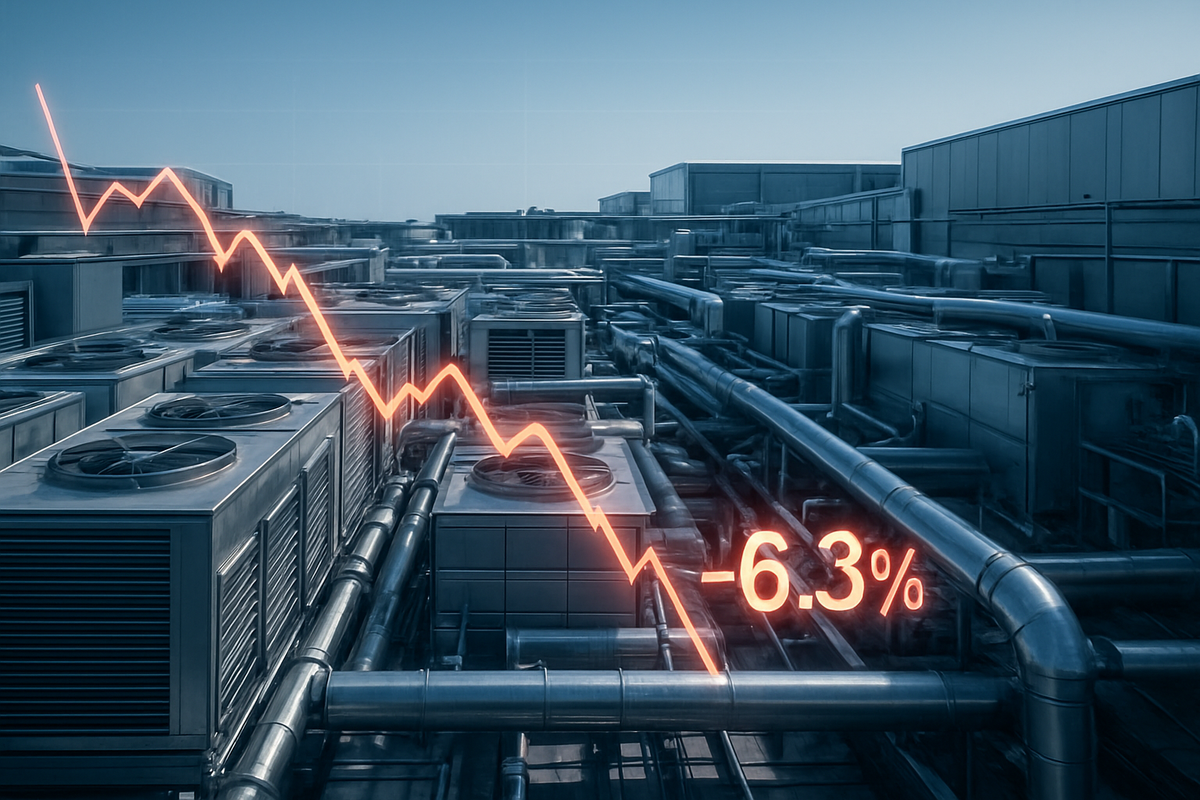
HOUSTON — The meteoric rise of the industrial services sector faced a sharp correction on Tuesday as shares of Comfort Systems USA (NYSE: FIX) plummeted 6.3%, marking one of the sharpest single-day declines for the HVAC and mechanical contracting giant in recent years. The drop, which saw the stock slide from a previous close of $1,032.31 to approximately $967.50, signals a growing apprehension among investors that the breakneck pace of AI-driven infrastructure development may be entering a period of consolidation.
The sell-off on January 6, 2026, wiped billions in market capitalization from the Houston-based firm, which had been a darling of Wall Street throughout 2025. While the broader market remained relatively stable, the outsized move in FIX suggests that the "premium" valuation previously afforded to companies tied to the data center buildout is now being scrutinized under the lens of rising material costs and potential shifts in federal trade policy.
Valuation Peaks and Analyst Skepticism
The decline was not triggered by a single catastrophic event but rather a "perfect storm" of valuation resets and strategic downgrades. Comfort Systems USA entered 2026 trading at a staggering 42.5 times its earnings per share (EPS), nearly double its five-year historical average. This stretched valuation left the stock vulnerable to any hint of negative sentiment. The catalyst arrived via a series of analyst downgrades; Zacks Investment Research moved the stock from a "Strong Buy" to "Hold" in late December, followed by Wall Street Zen, which lowered its rating on January 3, 2026, citing that the stock’s 120% rally over the previous twelve months had finally hit a ceiling.
Furthermore, the market began pricing in the reality of a $9.38 billion backlog. While a record figure, investors expressed concern that the high-margin technology and manufacturing projects that comprise this backlog could be delayed by the "affordability crisis" in the HVAC sector and persistent labor shortages. As the calendar turned to 2026, the initial euphoria surrounding the AI infrastructure cycle met the hard reality of execution risks, leading institutional investors to lock in profits.
Winners, Losers, and the Divergence of Industrial Giants
The impact of Tuesday’s trading session was felt unevenly across the industrial services landscape. While Comfort Systems USA bore the brunt of the selling pressure, its primary competitors showed more resilience. Quanta Services (NYSE: PWR) saw a more modest decline of 1.21%, closing at $430.54. Quanta's broader exposure to renewable energy and electrical grid modernization likely provided a cushion that the more HVAC-centric Comfort Systems lacked. Similarly, EMCOR Group (NYSE: EME) remained virtually flat, ending the day at $653.57, as investors viewed its more measured 2025 growth as a sign of stability rather than overextension.
In this environment, the "winners" may ironically be the value-oriented industrial firms that avoided the AI-hype cycle. However, the true losers in this shift are the aggressive growth funds that heavily overweighted FIX at its peak of over $1,100. Additionally, data center developers may find themselves in a tighter spot; if contractors like Comfort Systems begin to see margin compression due to rising labor and material costs—exacerbated by 2026 trade tariffs—the cost of building the next generation of AI hubs could rise significantly, potentially cooling the expansion plans of tech giants like NVIDIA (NASDAQ: NVDA).
The AI Infrastructure Cycle and Macro Headwinds
This event fits into a broader trend of "normalization" within the industrial sector. For much of 2024 and 2025, the market treated mechanical and electrical contractors as proxy tech stocks, fueled by the massive cooling requirements of AI-capable data centers. However, the 6.3% drop reflects a realization that these are still, at their core, labor-intensive construction businesses subject to the laws of physics and economics. The "Industrial AI" movement, championed by firms like Siemens (OTC: SIEGY), continues to promise long-term efficiency, but it cannot immediately solve the chronic shortage of skilled technicians required to install and maintain these complex systems.
Regulatory and policy shifts are also playing a major role. As the U.S. government implements new trade tariffs in early 2026, the cost of specialized components and raw materials is expected to rise. For a company like Comfort Systems, which operates on fixed-price or cost-plus contracts, the ability to pass these costs onto customers without stalling demand is a significant uncertainty. Historically, similar valuation resets occurred in the early 2000s and 2010s when infrastructure booms outpaced the underlying economic growth, leading to periods of "sideways" trading as earnings caught up to stock prices.
Looking Ahead: Earnings and Strategic Pivots
The immediate focus for investors will shift to February 19, 2026, when Comfort Systems is scheduled to release its fourth-quarter 2025 earnings. This report will be critical in determining whether the 6.3% drop was a temporary correction or the beginning of a longer-term bear trend. Management will need to provide clarity on how they intend to protect margins in the face of rising costs and whether they are seeing any cancellations or deferrals in their massive backlog.
In the short term, we may see a strategic pivot toward high-performance retrofits and electrification. As new construction costs soar, many enterprise customers are opting to upgrade existing facilities rather than build new ones. This shift toward lifecycle maintenance and "as-a-service" models could provide a more stable, recurring revenue stream that is less susceptible to the boom-and-bust cycles of the construction market. The challenge for FIX will be maintaining its growth narrative while transitioning into a more defensive posture.
Summary of the Market Outlook
The 6.3% decline in Comfort Systems USA serves as a potent reminder that even the strongest industrial players are not immune to the pressures of overvaluation and macro-economic shifts. The key takeaway for investors is that the "easy money" in the AI infrastructure trade has likely been made. Moving forward, the market will reward companies that can demonstrate disciplined execution and margin resilience over those that merely boast large backlogs.
In the coming months, watch for stabilization in the industrial services sector as a whole. If competitors like EMCOR and Quanta continue to hold steady, it suggests that the FIX drop was a company-specific valuation reset. However, if the sell-off spreads, it may indicate a broader cooling of the U.S. industrial expansion. Investors should keep a close eye on labor participation rates and material price indices, as these will be the true barometers for the sector's health in 2026.
This content is intended for informational purposes only and is not financial advice.