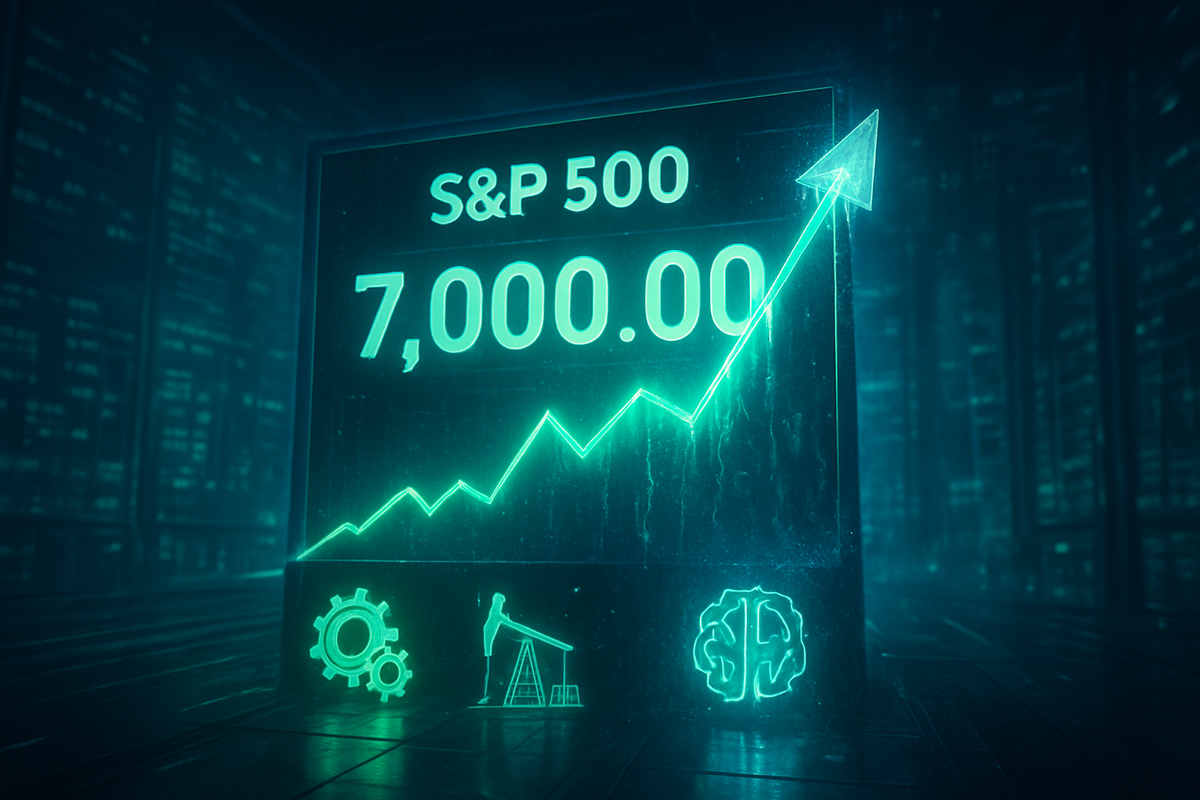
In a watershed moment for global equity markets, the S&P 500 (INDEXSP:.INX) briefly conquered the psychological 7,000-point milestone in late January 2026, marking the fastest 1,000-point ascent in the index's history. This historic peak, driven by a relentless "melt-up" in Artificial Intelligence (AI) valuations, saw the index touch an all-time intraday high of 7,002.28 on January 28, 2026. However, the celebration was short-lived as the "handle" proved to be a formidable technical ceiling, sparking a wave of volatility that has come to define the first half of February.
The breach has triggered a violent "momentum unwind" as investors grapple with "CapEx anxiety" surrounding the massive infrastructure spending of tech giants. As of mid-February, the market is witnessing a profound rotation, where the capital that fueled the AI revolution is now flowing into undervalued cyclical sectors. While the headline index has retreated from its peak, the underlying market breadth is expanding, suggesting that while the "Magnificent Seven" era may be cooling, the broader bull market is attempting to find a more sustainable, diversified footing.
The Fortress at 7,000: A Timeline of the Breach
The march toward 7,000 began in earnest during the final week of January 2026, catalyzed by a "Big Tech Week" that initially seemed destined to shatter all records. On January 28, Microsoft (NASDAQ: MSFT) released a staggering earnings report highlighting a $281 billion AI service backlog, providing the final thrust needed to push the S&P 500 above the 7,000 mark shortly after the opening bell. Traders on the floor described an atmosphere of euphoria that quickly turned to tactical maneuvering as the index hit what analysts called a "Gamma Wall."
This Gamma Wall—a massive concentration of options positioning at the 7,000 strike price—acted as a mechanical ceiling. Market makers were forced to sell index futures to remain delta-neutral as the price rose, effectively capping the rally. Despite the intraday breach, the S&P 500 failed to secure a daily close above the milestone, finishing the session at 6,999.71. For the following week, the index "pinned" near this level, unable to overcome the 161.8% Fibonacci extension of the early-2025 correction.
By the first full week of February, the narrative shifted from "growth at any price" to "show me the ROI." On February 6, a significant divergence emerged: while the Dow Jones Industrial Average (INDEXDJX:.DJI) climbed to a record 50,000, the tech-heavy S&P 500 and Nasdaq began to stumble. A secondary wave of selling hit between February 9 and February 12, as a "Sisyphus moment" took hold. Each attempt by bulls to reclaim 7,000 was met with aggressive profit-taking, eventually pulling the index back to a critical technical floor near 6,941 by mid-month.
Winners and Losers: The Great Sector Rotation
The rotation out of mega-cap tech has created a stark contrast between the winners of the last decade and the newly minted leaders of 2026. The primary "losers" in this shift have been the AI infrastructure plays. NVIDIA (NASDAQ: NVDA), which approached a $5 trillion market cap during the January peak, saw its Relative Strength Index (RSI) plummet in February as investors voiced concerns over hardware saturation. Similarly, Alphabet (NASDAQ: GOOGL) faced a sharp decline after its earnings call revealed plans to further ramp up AI capital expenditures, spooking a market that is increasingly sensitive to margin compression.
Microsoft, despite its role in the 7,000 breach, entered a technical correction by mid-February, falling significantly from its peak as the sheer scale of its $37.5 billion quarterly capital expenditure began to weigh on its valuation multiples. Apple (NASDAQ: AAPL) also struggled, trading nearly 23% below its 52-week high as the rollout of "Apple Intelligence" failed to generate the hardware super-cycle many analysts had modeled for the 2026 fiscal year.
Conversely, the "winners" are found in the "old economy" and value-oriented sectors. As the cap-weighted index stalled, the Invesco S&P 500 Equal Weight ETF (NYSEARCA:RSP) hit new highs, signaling a healthy broadening of the market. Industrials have been the standout performers, with Caterpillar (NYSE: CAT) and FedEx (NYSE: FDX) surging on the back of resilient domestic manufacturing data. Energy has also seen a resurgence, led by ExxonMobil (NYSE: XOM), while defensive plays like Johnson & Johnson (NYSE: JNJ) have provided a safe harbor for capital exiting the volatile tech sector.
Significance of the 7,000 Ceiling
The struggle at 7,000 is more than just a round-number resistance; it represents a fundamental questioning of the "AI Premium" that has dominated equity markets since late 2023. Historically, milestones like 5,000 and 6,000 were met with similar periods of consolidation, but the 7,000 level is unique because it coincides with a projected $700 billion collective AI spend by Big Tech in 2026. The market is now demanding tangible evidence that these investments will translate into bottom-line growth, moving beyond the "build it and they will come" phase of the cycle.
This event also highlights the growing influence of "mechanical" market drivers. The role of the "Gamma Wall" and 0DTE (zero days to expiration) options in pinning the index at 7,000 demonstrates how derivative positioning can dictate price action regardless of fundamental news. This technical gravity has historically preceded periods of heightened volatility, drawing comparisons to the "Volmageddon" events of years past, though current bank capital requirements and market circuitry make a systemic collapse less likely.
Furthermore, the divergence between the Dow and the S&P 500 indicates a policy-sensitive market. With the Federal Reserve expected to hold rates steady through the second quarter of 2026, the cost of capital remains a headwind for high-multiple tech stocks. This has forced a re-evaluation of the "Risk-Free Rate" versus the "AI Growth Rate," leading to a healthier, albeit more volatile, distribution of wealth across different market caps and industries.
What Lies Ahead: Support Levels and Strategic Pivots
Looking forward, the immediate focus for technical analysts is the 6,945 support level. If the S&P 500 can hold this floor through the remainder of February, it would signal a "bullish consolidation" that could provide the base for a successful sustained break above 7,000 in the spring. However, a breach below 6,900 would likely trigger a deeper correction toward the 200-day moving average, potentially ending the parabolic phase of the current bull run.
Strategic pivots are already underway among institutional desks. Many hedge funds are moving toward "barbell strategies"—retaining exposure to top-tier AI software winners while aggressively adding to mid-cap value and international equities that have lagged the U.S. mega-caps. The "Magnificent Seven" trade is being replaced by a more nuanced "Magnificent Diversification" approach, where stock selection and sector timing are becoming more critical than simple index exposure.
In the long term, the breach of 7,000 will likely be remembered as the moment the AI narrative matured. We are entering a phase where the "picks and shovels" providers must pass the torch to the "users" of the technology. Companies that can demonstrate operational efficiency gains from AI—rather than those just building the chips—will likely be the leaders of the next leg of the bull market as we look toward the 7,500 target.
Summary and Investor Outlook
The S&P 500’s flirtation with 7,000 in early 2026 has provided a masterclass in market psychology and technical resistance. The failure to hold the milestone intraday and the subsequent rotation out of mega-cap tech suggest that the market is undergoing a necessary "clearing" of excess optimism. While the pullback in titans like NVIDIA and Microsoft has caused headline volatility, the strength in the Dow and the Equal-Weight S&P 500 indicates that the bull market remains intact, just under new leadership.
Investors should watch for a stabilization of tech valuations and a "cooling off" of the Gamma levels at the 7,000 strike before expecting another run at the highs. The key takeaways from the last few weeks are clear: breadth is improving, value is no longer a "trap," and the AI trade has shifted from speculation to execution. As we move deeper into 2026, the focus will remain on whether the 6,945 support holds and how quickly the "Great Rotation" can absorb the selling pressure from the tech giants.
This content is intended for informational purposes only and is not financial advice.