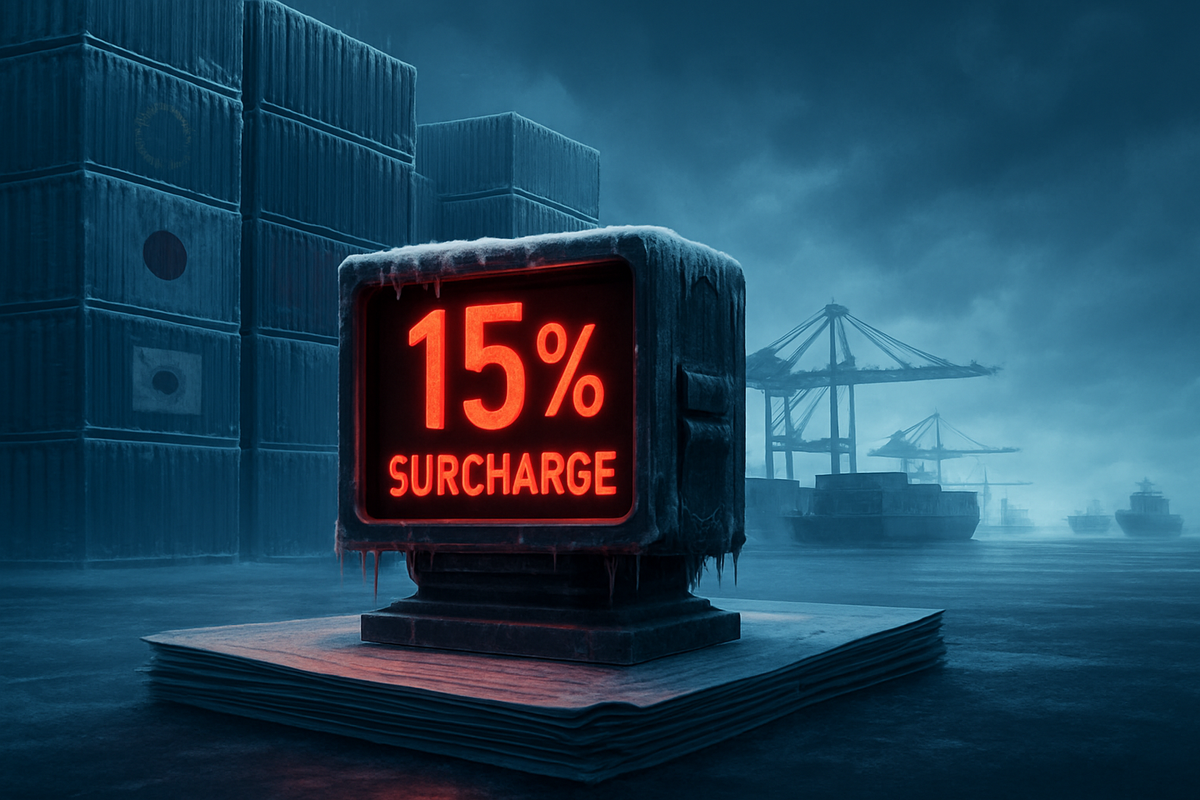
WASHINGTON, D.C. — The global trading order has descended into a state of unprecedented paralysis this week as the Trump administration’s sudden pivot to a 15% universal import surcharge triggered an immediate and fierce international backlash. By February 23, 2026, the diplomatic "peace-for-security" deals painstakingly negotiated over the past year have effectively shattered, with the European Union, Japan, and South Korea formally freezing trade ratifications and investment pledges in response to what they describe as a breach of international trust.
The move, which follows a landmark Supreme Court defeat for the administration just days ago, has left global ports in a state of "customs chaos" and sent shockwaves through equity markets. As the new 15% baseline rate—applied under Section 122 of the Trade Act of 1974—officially takes effect, the era of predictable bilateral trade appears to have been replaced by a volatile "stacking" tariff regime that threatens to plunge the global economy into a prolonged period of protectionist gridlock.
From Courtroom Defeat to "Plan B": The Road to Section 122
The current crisis was ignited on February 20, 2026, when the U.S. Supreme Court ruled 6–3 in Learning Resources, Inc. v. Trump that the administration’s use of the International Emergency Economic Powers Act (IEEPA) to impose broad "reciprocal" tariffs was unconstitutional. The ruling effectively voided three-quarters of the administration’s existing tariff revenue overnight, creating a massive fiscal and policy vacuum. In a defiant response on Saturday, February 21, President Trump signed an executive order invoking Section 122—a rarely used "balance-of-payments" authority—to impose a 10% global surcharge, which he rapidly escalated to the 15% statutory maximum within 24 hours.
The diplomatic fallout was instantaneous. On February 23, the European Parliament voted overwhelmingly to freeze the ratification of the "Turnberry Agreement," a landmark deal struck in mid-2025 that was supposed to cap EU-U.S. tariffs at 15%. Because the new surcharge is "stacked" on top of existing baseline duties, European exports now face cumulative rates as high as 30%. Bernd Lange, Chair of the European Parliament’s Trade Committee, characterized the situation as "pure customs chaos," noting that the legal ambiguity of the new U.S. policy has made it impossible for European firms to calculate their landed costs.
In Tokyo and Seoul, the reaction was equally severe. Japan has stalled the legislative ratification of its $550 billion investment pledge, citing "unforeseen administrative volatility." Meanwhile, the South Korean National Assembly has suspended work on a critical investment bill after the Trump administration threatened to raise duties on South Korean automobiles from 15% to 25% if Seoul did not immediately honor its previous spending commitments. Treasury Secretary Scott Bessent has defended the 15% surcharge as a necessary measure to address a $1.2 trillion goods trade deficit, but allies view the "stacking" of tariffs as a direct violation of previous "handshake deals."
Winners, Losers, and the Corporate Fallout
The "customs chaos" of February 2026 has created a stark divide across the corporate landscape. Apple (NASDAQ: AAPL) has emerged as a "relative winner" in this turbulent environment. While the 15% surcharge will cost the tech giant an estimated $3.3 billion annually, this flat rate replaces the far more aggressive 50%+ "reciprocal" duties that were struck down by the Supreme Court. Consequently, Apple shares saw a 4% gain this week as investors viewed the 15% floor as a "safe harbor" compared to the previous uncertainty.
Conversely, the automotive and luxury sectors are reeling. Toyota (NYSE: TM) warned of a staggering $9.5 billion impact for fiscal year 2026, with its operating margins expected to compress significantly as it navigates the new surcharge. General Motors (NYSE: GM) also signaled a profit hit of up to $4 billion, largely due to its reliance on South Korean-made models like the Chevrolet Trax, which are now caught in the crosshairs of the burgeoning dispute with Seoul. In the luxury space, LVMH (OTC: LVMUY) saw its shares slump 8% as its Wines & Spirits division faced a 25% profit drop; the 15% surcharge, combined with existing duties, has made French champagne and cognac prohibitively expensive for the "aspirational" U.S. consumer.
Retail giants are already signaling that the cost of this trade war will be passed directly to the American public. Walmart (NYSE: WMT) and Target (NYSE: TGT) both issued cautious guidance this week, with Walmart CFO John David Rainey noting that the company can no longer "eat the tariffs" and will begin aggressive price hikes on general merchandise to offset the Section 122 surcharge. Goldman Sachs (NYSE: GS) analysts warned that the "inventory cushion" built up by retailers in late 2025 has evaporated, leaving no buffer against the new 15% price floor.
A Return to 1974: The Wider Significance of Section 122
The shift from "reciprocal" tariffs to a Section 122 surcharge marks a fundamental change in U.S. trade strategy. By invoking this specific section of the Trade Act of 1974, the administration is bypassing the legislative hurdles that tripped up its previous efforts. Section 122 allows the President to restrict imports for up to 150 days to address "large and serious" balance-of-payments deficits without prior Congressional approval. This move essentially weaponizes a tool designed for temporary economic emergencies, turning it into a permanent fixture of foreign policy.
This event mirrors the 1971 "Nixon Shock," when a 10% surcharge was used to force a realignment of global currencies. However, the 2026 version is significantly more complex due to the interconnected nature of modern supply chains. The "stacking" effect—where the 15% surcharge is added to existing duties rather than replacing them—has created a "regulatory fog" that historical precedents struggle to match. Morgan Stanley (NYSE: MS) economists argue that this move toward "unilateral surcharge authority" could lead to a permanent de-globalization, as allies like Japan and the EU move to decouple their investment strategies from U.S. political cycles.
The 150-Day Clock: What Comes Next?
The immediate future hinges on the 150-day expiration window built into Section 122. Under the law, the 15% surcharge must be reviewed or allowed to expire by late July 2026, unless the administration can secure a Congressional extension or find a new legal justification. This creates a high-stakes "ticking clock" for trade negotiations. In the short term, expect a flurry of "emergency exemptions" as the administration attempts to use the 15% rate as a bargaining chip to force the EU and Japan back to the negotiating table.
Strategically, companies will likely pivot toward "accelerated re-shoring" or "tariff-hopping" investments. We are already seeing Apple fast-track a $500 billion U.S. investment plan to secure potential future exemptions. For investors, the next several months will be characterized by extreme volatility as the market attempts to price in the possibility of a 25% "escalation rate" if bilateral deals are not ratified by mid-summer. The potential for a "tit-for-tat" retaliatory cycle from the EU—specifically targeting U.S. tech and energy exports—remains the largest "black swan" risk on the horizon.
Final Assessment: A New Era of Trading Volatility
The events of February 2026 represent a definitive end to the post-WWII era of liberalized trade. The "customs chaos" triggered by the 15% universal surcharge is not merely an administrative hurdle; it is a signal that the U.S. is prepared to use its market access as a blunt instrument of national power, even at the cost of alienating its closest security allies. The freezing of ratifications in Brussels, Tokyo, and Seoul suggests that the world’s largest economies are no longer willing to "pay for play" if the rules of the game can be changed overnight by executive order.
Moving forward, investors should watch for two key indicators: first, the response of the U.S. consumer to the late-February price hikes at major retailers, and second, the potential for a "unified front" among the EU, Japan, and South Korea in the WTO or other international forums. The 15% surcharge has created a new, permanent price floor for global goods, and the "customs chaos" of this week may just be the opening chapter of a much longer, more expensive era of economic nationalism.
This content is intended for informational purposes only and is not financial advice.