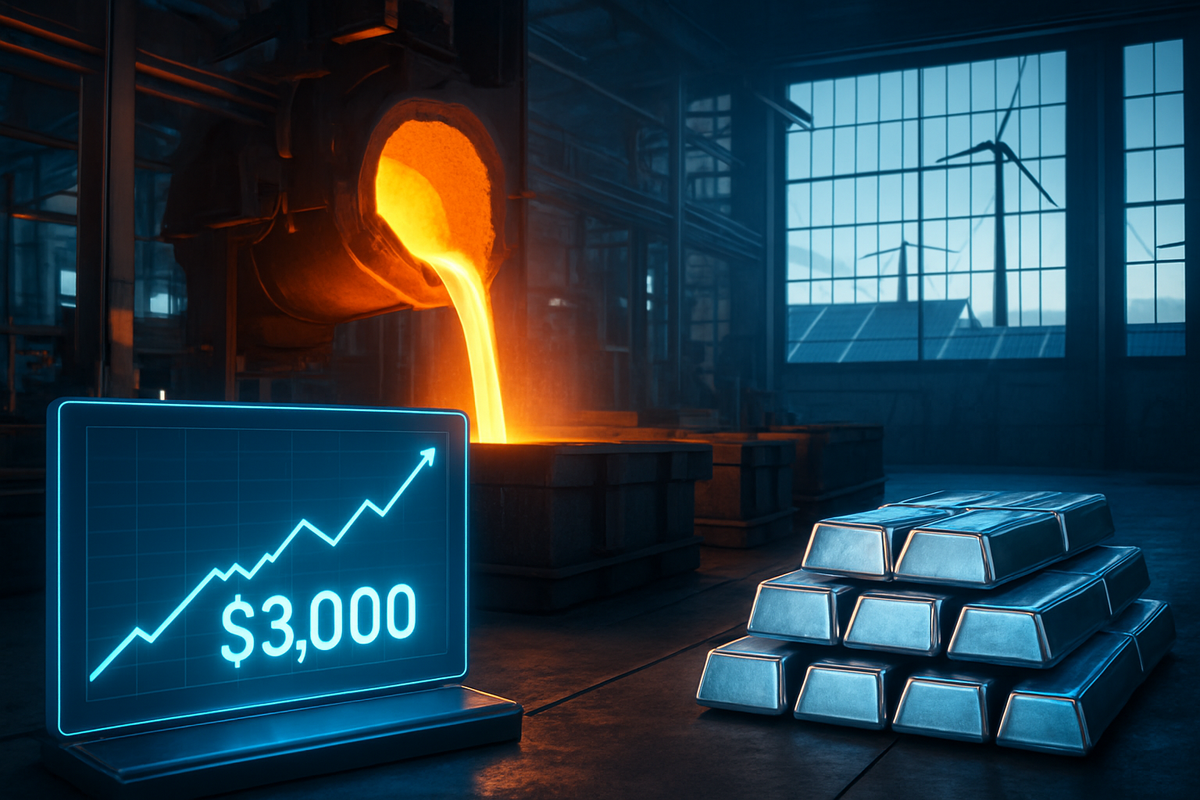
As of March 23, 2026, the global aluminum market has entered a period of unprecedented volatility and record-breaking valuations, with prices on the London Metal Exchange (LME) decisively breaching the $3,000 per tonne threshold. This surge, which has seen spot prices climb as high as $3,220 in recent weeks, marks a multi-year peak fueled by a "perfect storm" of structural supply deficits and an insatiable appetite for the "green metal" from the energy transition sector. For manufacturers and investors alike, the long-predicted 2026 supply crunch is no longer a forecast—it is a reality that is reshaping industrial supply chains across the globe.
The immediate implications of this price rally are being felt from Detroit to Dusseldorf. With aluminum serving as a critical component in everything from soda cans to fighter jets, the current price levels are stoking fears of renewed inflationary pressure. However, unlike previous spikes driven by temporary logistics bottlenecks, the 2026 rally is rooted in a fundamental shift in global trade dynamics: the end of China’s era as the world’s primary aluminum exporter and the definitive implementation of aggressive carbon-border taxes in the West.
The Perfect Storm: Production Caps and Geopolitical Chokepoints
The road to $3,000 per tonne was paved by a series of cascading supply constraints that began to tighten in late 2025. Central to this narrative is China’s rigid 45-million-tonne primary aluminum capacity ceiling. For decades, the Aluminum Corp of China (HKG: 2600), commonly known as Chalco, and its domestic peers flooded global markets with low-cost metal. However, as of early 2026, Beijing has strictly enforced its "capacity-for-capacity" replacement policy to meet national decarbonization goals. With China now consuming more aluminum than it produces to feed its massive solar and electric vehicle (EV) industries, the world has lost its primary "swing producer," effectively turning the Middle Kingdom into a net importer of primary metal.
Adding fuel to the fire, a geopolitical "black swan" event in February 2026 saw significant disruptions in the Strait of Hormuz, a vital artery for Middle Eastern aluminum exports. Producers in the region, which account for nearly 9% of global supply, were forced to declare force majeure on several shipments to Europe and Asia. This sudden evaporation of liquidity in the spot market sent buyers scrambling, pushing the LME three-month contract from $2,700 to over $3,100 in less than thirty days. Markets were further rattled when the European Union’s Carbon Border Adjustment Mechanism (CBAM) entered its "definitive phase" on January 1, 2026, imposing heavy levies on high-carbon aluminum and effectively bifurcating the market into "green" and "gray" metal.
Winners and Losers in the High-Price Era
The primary beneficiaries of this price surge are Western producers with access to low-carbon energy sources. Alcoa (NYSE: AA) has seen its valuation climb as it capitalizes on its portfolio of hydro-powered smelters. In its most recent quarterly guidance, Alcoa noted that the "green premium" for low-carbon aluminum has widened to a record $150 per tonne above the LME base price. Similarly, Rio Tinto (NYSE: RIO) has leveraged the supply tightness to negotiate record premiums for its Q2 2026 contracts with Japanese buyers, reporting a 20% year-over-year increase in realized prices. Norsk Hydro (OTCMKTS: NHYDY) also stands as a strategic winner, as its early investment in "HalZero" carbon-capture technology has made its product the gold standard for European automakers looking to minimize their scope-3 emissions.
Conversely, the "losers" in this environment are primarily downstream manufacturers and high-carbon producers located in coal-dependent regions. Century Aluminum (NASDAQ: CENX) has faced headwinds due to fluctuating energy costs in the U.S. Midwest, despite the high metal prices. More significantly, the automotive sector—led by giants like Ford Motor Company (NYSE: F) and Tesla (NASDAQ: TSLA)—is facing a margin squeeze. With EVs requiring between 200kg and 350kg of aluminum per vehicle, a $500 per tonne increase in the metal's price adds hundreds of dollars to the production cost of every car. Companies that failed to secure long-term, fixed-price contracts or failed to invest in closed-loop recycling systems are now finding their 2026 profitability targets under severe threat.
The "Green Metal" Transformation and Shifting Trade Policies
The current market dynamics reflect a broader industry trend where aluminum is being rebranded from a simple commodity to a strategic "energy transition metal." This shift is underscored by the explosive growth in solar infrastructure and the electrification of everything. Solar PV installations, which require nearly 2 tons of aluminum per megawatt for mounting frames, have become a cornerstone of demand, rivaling the traditional construction sector. This demand is increasingly inelastic; as governments push for net-zero targets by 2030, the need for aluminum in renewable infrastructure remains high regardless of the price, creating a floor for the market that didn't exist a decade ago.
The regulatory landscape has also undergone a seismic shift. The implementation of CBAM in the EU and similar discussions in the U.S. have effectively ended the era of "global" aluminum prices. We are now seeing a regionalized market where trade policies dictate profit margins as much as supply and demand do. Historically, aluminum prices were governed by the cost of energy and bauxite; in 2026, they are governed by the "carbon intensity" of the smelting process. This mirrors the transformation seen in the European carbon credit markets and suggests that the aluminum industry is becoming a laboratory for how global trade will function in a decarbonizing world.
Looking Ahead: Innovation or Stagnation?
In the short term, the market is bracing for further volatility. Analysts at major investment banks suggest that if the Middle Eastern shipping disruptions persist into the summer, aluminum could test the $3,500 level. Such a spike would likely trigger "demand destruction" in lower-margin sectors like packaging and standard construction, as companies pivot to cheaper alternatives like plastic or steel where possible. However, for the high-tech and renewable sectors, the only viable path forward is innovation. We expect to see a massive uptick in investment toward aluminum recycling (secondary production), which requires only 5% of the energy compared to primary smelting and carries a fraction of the carbon footprint.
Long-term, the strategic pivot for many companies will involve securing supply through "near-shoring" and vertical integration. We are already seeing firms like Alcoa (NYSE: AA) explore the repurposing of idled smelter sites for AI data center cooling and power busbars, tapping into a new and lucrative demand pillar. The 2026 supply crunch may ultimately be remembered as the catalyst that forced the industry to move away from primary smelting toward a "circular aluminum economy," where the metal is recovered and reused with infinite efficiency.
Summary of the 2026 Aluminum Landscape
The aluminum market of 2026 has reached a historic inflection point. The breach of the $3,000 per tonne mark is the result of a structural deficit driven by China’s production caps, geopolitical instability, and a massive surge in demand from the EV and renewable sectors. While producers with green credentials like Rio Tinto (NYSE: RIO) and Norsk Hydro (OTCMKTS: NHYDY) are reaping the rewards, downstream industries are grappling with an era of "permanent" high input costs.
Moving forward, the market will be defined by the scarcity of "green" primary metal and the speed at which recycling infrastructure can be scaled. Investors should keep a close eye on China’s import volumes and any potential easing of the 45-million-tonne cap, as well as the widening "green premium" in European and North American markets. Aluminum has officially shed its status as a boring industrial base metal and has emerged as a high-stakes frontline in the global energy transition.
This content is intended for informational purposes only and is not financial advice.