Caterpillar Inc. (NYSE: CAT) has long been the primary barometer for the global construction and mining industries, but in early 2026, the industrial giant has found a new, high-voltage catalyst: the artificial intelligence revolution. As of January 13, 2026, Caterpillar’s stock has surged into a fresh technical "buy zone" between $620 and $640, fueled by a wave of analyst upgrades that recharacterize the "Yellow Reliable" as a critical linchpin in the global data center build-out.
The shift in sentiment follows a realization among institutional investors that the primary bottleneck for generative AI is no longer just high-end chips, but the massive amounts of electrical power required to run them. With utility grids across the United States and Europe struggling to keep pace with the exponential demand from hyperscale data centers, Caterpillar has stepped into the breach, transforming its Energy & Transportation (E&T) segment into a high-growth engine that now accounts for nearly half of the company’s total revenue.
The momentum behind Caterpillar reached a fever pitch this week as several major Wall Street firms raised their price targets, citing a structural shift in the company’s business model. Citigroup Inc. (NYSE: C) led the charge, with analyst Kyle Menges raising his target to $710 and labeling Caterpillar the "undisputed titan" of the industrial sector. Not far behind, JPMorgan Chase & Co. (NYSE: JPM) maintained a bullish outlook with a $730 target, while Jefferies Financial Group Inc. (NYSE: JEF) boosted its objective to $700. These upgrades were catalyzed by Caterpillar’s massive $39.8 billion order backlog, which provides clear revenue visibility through 2027.
The technical "buy zone" identified by market analysts followed a breakout move in late December 2025, where the stock cleared a long-term consolidatory base. This rally was underpinned by tangible industrial moves, most notably a landmark 4-gigawatt (GW) contract with Joule Capital Partners to provide on-site power for a massive data center campus in Utah. To meet this "insatiable" demand, Caterpillar recently announced a $725 million investment to expand its Lafayette, Indiana, facility, a move intended to double its turbine engine production capacity by 2030.
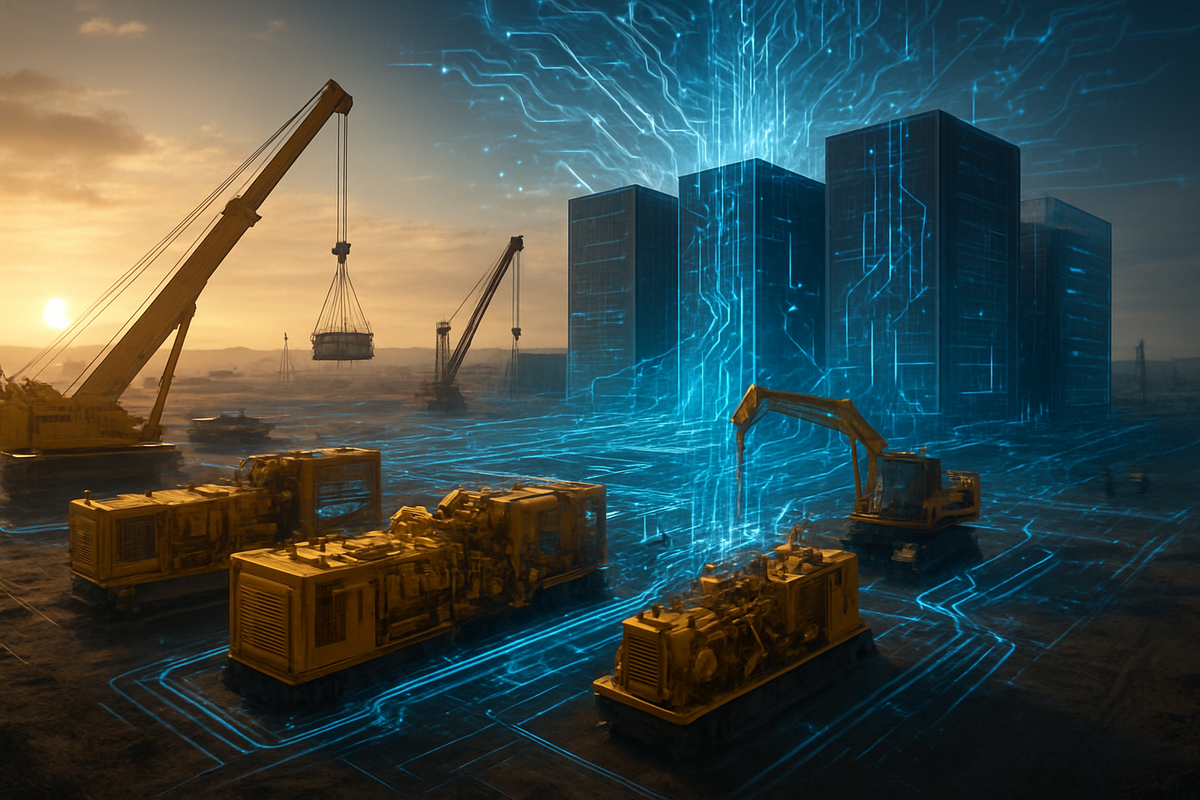
At the heart of this growth are high-specification products like the G3520K generator sets—2.5MW natural gas-fired reciprocating engines that have become the gold standard for large-scale data center prime power. Additionally, Caterpillar’s Solar Turbines subsidiary is seeing unprecedented demand for its Titan 350 gas turbines. These units allow data center operators to bypass strained local utility grids entirely, creating "off-grid" hyperscale facilities that can be brought online years faster than those waiting for traditional grid connections.
While Caterpillar is the primary beneficiary of this trend, the competitive landscape of 2026 has created a distinct set of winners and losers. Vertiv Holdings Co (NYSE: VRT) has emerged as a key strategic partner for Caterpillar, as the two companies recently formed an alliance to offer "Bring Your Own Power & Cooling" (BYOP&C) architectures. This partnership allows Vertiv to integrate its liquid cooling and modular power distribution systems directly with Caterpillar’s heavy-duty engines, providing a turn-key solution for tech giants like Microsoft (NASDAQ: MSFT) and Meta Platforms (NASDAQ: META).
Cummins Inc. (NYSE: CMI) remains Caterpillar’s most formidable rival, positioning itself as a vertically integrated alternative. Cummins has seen its own share of "AI infrastructure" glory, recently securing a $200 million agreement with AVAIO Digital for AI-ready campuses. However, analysts suggest that while Cummins dominates the high-reliability backup market, Caterpillar’s dominance in large-scale natural gas turbines gives it a unique edge in the burgeoning "primary on-site power" market where data centers act as their own utilities.
The "losers" in this paradigm shift are increasingly the traditional utility companies. Firms like Dominion Energy Inc. (NYSE: D) and Duke Energy Corp (NYSE: DUK) are facing a "power gap" crisis. Transmission bottlenecks and regulatory hurdles for new transmission lines have made it difficult for utilities to meet the 18-month build cycles of data center developers. As hyperscalers turn to Caterpillar for on-site gas generation, utilities risk losing high-margin industrial customers to the "grid independence" movement, potentially leaving residential ratepayers to shoulder the costs of legacy infrastructure.
The transformation of Caterpillar from a cyclical tractor manufacturer to an AI infrastructure play fits into a broader industrial "Supercycle." Historically, Caterpillar’s fortunes were tied to global GDP and commodity prices. However, the current era is defined by the "Infrastructure Supercycle," where the physical world must be rapidly retrofitted to support the digital world. This shift has led to higher, more sustainable margins as the company's business mix pivots toward high-value power systems and recurring service revenues, which the company aims to grow to $30 billion by 2030.
This trend also highlights a growing policy conflict between the rapid deployment of AI and environmental goals. To meet the immediate power needs of AI, developers are relying heavily on natural gas-fired generation from Caterpillar turbines, often bypassing renewable energy mandates that the grid cannot yet support. Regulatory bodies like the PJM Interconnection are already tightening rules to protect grid reliability, which ironically pushes more developers toward the self-contained power solutions that Caterpillar provides.
The historical precedent for this moment might be the early 20th-century electrification of industry, where factories transitioned from steam to electric power. Today, the data center is the new factory, and "compute" is the new product. Caterpillar is effectively providing the "steam engine" for the digital age, a role that commands a significantly higher valuation multiple than its traditional roles in earthmoving and mining.
Looking ahead to the remainder of 2026, the primary challenge for Caterpillar will be execution. With a record backlog and ambitious expansion plans in Indiana, the company must manage complex supply chains for large-scale engines that have lead times often exceeding 12 months. Investors will be closely watching the Q1 2026 earnings call for updates on whether the company can further accelerate its manufacturing throughput to meet the "off-grid" surge.
In the long term, Caterpillar may face a strategic pivot toward hydrogen-ready engines and carbon capture technologies. As tech giants face increasing pressure to meet "Net Zero" commitments, the natural gas turbines currently driving Caterpillar's growth will eventually need to be decarbonized. Caterpillar has already begun testing 100% hydrogen-capable reciprocating engines, and the success of these trials will determine if the company can maintain its "AI infrastructure" crown through the end of the decade.
The story of Caterpillar in 2026 is one of a legacy industrial giant successfully reinventing itself for the silicon age. By providing the literal power behind the virtual world, CAT has moved beyond the volatility of the construction cycle and into the secular growth of the AI revolution. The current "buy zone" reflects a market that is only beginning to price in the full value of "grid independence" and the critical role of on-site power generation.
For investors, the key takeaways are clear: Caterpillar is no longer just a play on global growth, but a specific bet on the physical infrastructure of AI. As long as the demand for machine learning exceeds the capacity of the electrical grid, Caterpillar’s Energy & Transportation segment will likely remain the company's most potent catalyst. Moving forward, the market will be watching for backlog growth, the progress of the Lafayette expansion, and any further strategic alliances that solidify Caterpillar's position at the intersection of heavy industry and high tech.
This content is intended for informational purposes only and is not financial advice.