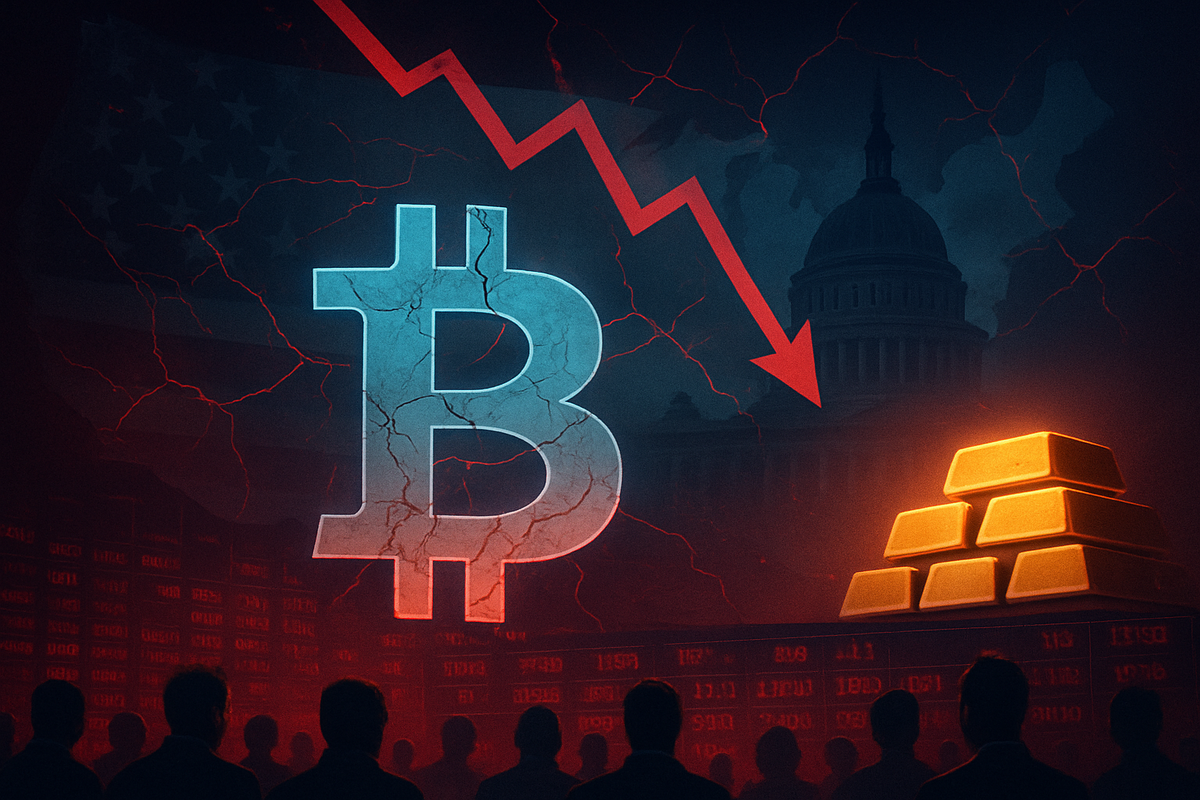
The global cryptocurrency market faced another wave of turbulence on Monday, February 23, 2026, as Bitcoin (BTC) saw its price tumble 4.8%, briefly flirting with the critical $64,000 support level. The slide comes on the heels of a weekend announcement from the White House regarding a significant escalation in global trade tariffs, which has sent shockwaves through high-risk asset classes. Investors are increasingly pivoting toward a "Sell America" strategy, offloading U.S.-linked assets—including digital currencies—in favor of traditional hedges like gold, which recently hit historic highs.
This latest volatility underscores a growing disconnect between the "digital gold" narrative and actual market performance. As Bitcoin trades near $64,300, analysts are warning that the asset’s high correlation with U.S. equities and sensitivity to trade policy is weighing heavily on its valuation. The immediate implication is a market gripped by "extreme fear," with institutional investors deleveraging to protect capital against a backdrop of geopolitical uncertainty and domestic regulatory upheaval.
A Month of Deleveraging: The Path to $64,000
The current slump is part of a broader, more painful correction that has defined February 2026. The month began with a dramatic "flash crash" on February 5, where Bitcoin plummeted 11% in a single day, briefly breaking below $64,000 to reach an intraday low of $62,702. That event saw over $2.56 billion in positions liquidated within 24 hours, marking a 15-month low for the world’s largest cryptocurrency. While the market attempted a modest recovery in the following weeks, the respite was short-lived.
The catalyst for the current February 23 slide was a Saturday announcement by President Donald Trump to raise global tariffs from 10% to 15% under Section 122 of the Trade Act of 1974. This move followed a Supreme Court ruling that had invalidated previous emergency tariff measures, prompting the administration to take a more aggressive stance. Market participants reacted swiftly on Monday morning, viewing the tariffs as a dual threat: an inflationary pressure that could keep interest rates high and a potential drag on global GDP growth.
Key stakeholders, including institutional desk heads and crypto whales, have shifted into defensive postures. The sentiment has been further soured by a cloud of uncertainty surrounding the Federal Reserve. Reports of a criminal investigation into Fed Chair Jerome Powell and the nomination of Kevin Warsh to the board have led to questions about the central bank’s independence, making the U.S. dollar-denominated assets appear increasingly risky to global observers.
Winners and Losers in the Crypto Fallout
Publicly traded companies with direct exposure to the crypto ecosystem are feeling the brunt of the volatility. Coinbase Global, Inc. (NASDAQ: COIN) has seen its stock price crater by approximately 34% year-to-date. The exchange recently reported a staggering $666.7 million loss for the final quarter of 2025, a result of thinning trading volumes and a cautious institutional client base. On February 17, Mizuho Securities slashed its price target for Coinbase from $280 to $170, citing a "structural shift" in how investors are approaching crypto exchanges during periods of high macro uncertainty.
MicroStrategy Inc. (NASDAQ: MSTR) continues to be the most aggressive player in the space, though its strategy is facing its toughest test yet. Despite the market downturn, the company purchased an additional 2,486 BTC for $168.4 million between February 9 and 16 as part of its ambitious "42/42 Plan." However, with an average purchase price now hovering near $76,027 per coin, the company’s massive 717,131 BTC treasury is currently "under water." This has pressured its stock price to stay well below its 200-day moving average, prompting analysts to lower their price targets for MSTR from $403 to $320.
The mining sector is also under significant duress. Riot Platforms, Inc. (NASDAQ: RIOT) saw its shares drop 10% during the mid-February sell-offs as the combination of falling Bitcoin prices and high energy costs squeezed profit margins to the breaking point. Meanwhile, Robinhood Markets, Inc. (NASDAQ: HOOD) has not been immune, losing over 8% of its value during the initial February 5 crash as retail participation in crypto trading slowed to a crawl. Conversely, the "winner" in this scenario appears to be the precious metals market, with physical gold surging past $5,400 per ounce as the preferred destination for capital fleeing U.S.-centric risk.
The 'Sell America' Trade and the Shifting Narrative
The emergence of the "Sell America" trade marks a significant shift in the global financial landscape. For years, Bitcoin was touted as a hedge against traditional financial system failures. However, in 2026, the asset’s increased integration with the U.S. financial system—largely through ETFs and institutional adoption—has made it a victim of the very system it was meant to provide an alternative to. As investors flee U.S. equities and the dollar due to tariff-induced inflation fears and Fed instability, Bitcoin is being sold off alongside the S&P 500.
This event fits into a broader trend of deglobalization. The 15% tariff hike is not just a trade policy; it is a signal of a more isolationist U.S. economic stance that is forcing global investors to reconsider their weightings in American assets. Historically, Bitcoin has thrived on liquidity, but with the Federal Reserve in turmoil and the White House pursuing protectionist policies, the liquidity taps are tightening.
Comparisons are being drawn to the market jitters of late 2018 and the trade wars of 2019, but the scale of the current volatility is magnified by the sheer size of the crypto market. The regulatory implications are also mounting; with the Fed leadership in question, the path for crypto-specific legislation or a central bank digital currency (CBDC) has become even more murky, further driving investors toward the perceived safety of gold and other non-U.S. sovereign assets.
What Lies Ahead: The $60,000 Line in the Sand
As the market enters the final week of February, all eyes are on the $60,000 mark. Analysts describe this as the ultimate "line in the sand"; a break below this level could trigger a fresh round of institutional liquidations and force companies like MicroStrategy to rethink their aggressive accumulation strategies. In the short term, the market expects continued volatility as the full impact of the 15% tariffs is priced into global supply chains.
Strategic pivots may be required for the industry to survive this downturn. Mining firms like Riot Platforms may need to diversify into high-performance computing (HPC) or AI data centers to offset the loss in Bitcoin revenue. For exchanges like Coinbase, the focus may shift toward international expansion to reduce reliance on the U.S. regulatory and economic environment.
Potential scenarios range from a "V-shaped" recovery if the Fed settles its leadership issues quickly, to a prolonged "crypto winter" if trade tensions escalate into a full-blown global recession. The market is currently pricing in a high probability of the latter, necessitating a cautious approach for anyone holding high-beta assets.
Market Outlook and Final Thoughts
The events of February 2026 serve as a stark reminder that Bitcoin is not yet the decoupled safe haven many hoped it would become. The dip below $64,000 is a direct symptom of a global market grappling with the "Sell America" trade, fueled by aggressive tariffs and institutional instability. The key takeaways for investors are clear: macro-economic policy currently outweighs crypto-native fundamentals, and the correlation between BTC and U.S. risk assets remains stubbornly high.
Moving forward, the market is likely to remain in a "wait-and-see" mode. Investors should closely monitor the implementation of the new tariff structures and the ongoing drama at the Federal Reserve. While the long-term thesis for decentralized finance remains, the short-term reality is one of defensive maneuvering. The coming months will determine whether Bitcoin can reclaim its status as a hedge or if it will continue to be a casualty of the shifting winds of global trade.
This content is intended for informational purposes only and is not financial advice