SANTA CLARA, Calif. — In a display of market resilience that has silenced skeptics of the AI "plateau," NVIDIA (NASDAQ: NVDA) has officially recorded its longest winning streak in nearly two and a half years. As of the closing bell on April 14, 2026, the semiconductor giant secured its 10th consecutive session of gains, a feat not seen since the height of the initial generative AI explosion in November 2023. The rally has propelled the stock to approximately $192, successfully breaking out of a multi-month consolidation phase and reasserting the company’s dominance over the global technology landscape.
The 10-day surge reflects a renewed wave of investor confidence as the industry pivots from basic Large Language Models (LLMs) toward "Agentic AI"—autonomous systems capable of complex reasoning and task execution. This momentum was further catalyzed by NVIDIA’s blockbuster Q1 FY2027 revenue guidance of $78 billion and the formal unveiling of its "Ising" Quantum AI platform. For the market, the message is clear: the hardware bottleneck remains the primary gatekeeper of digital evolution, and NVIDIA still holds the keys.
A Perfect Storm of Innovation and Financial Strength
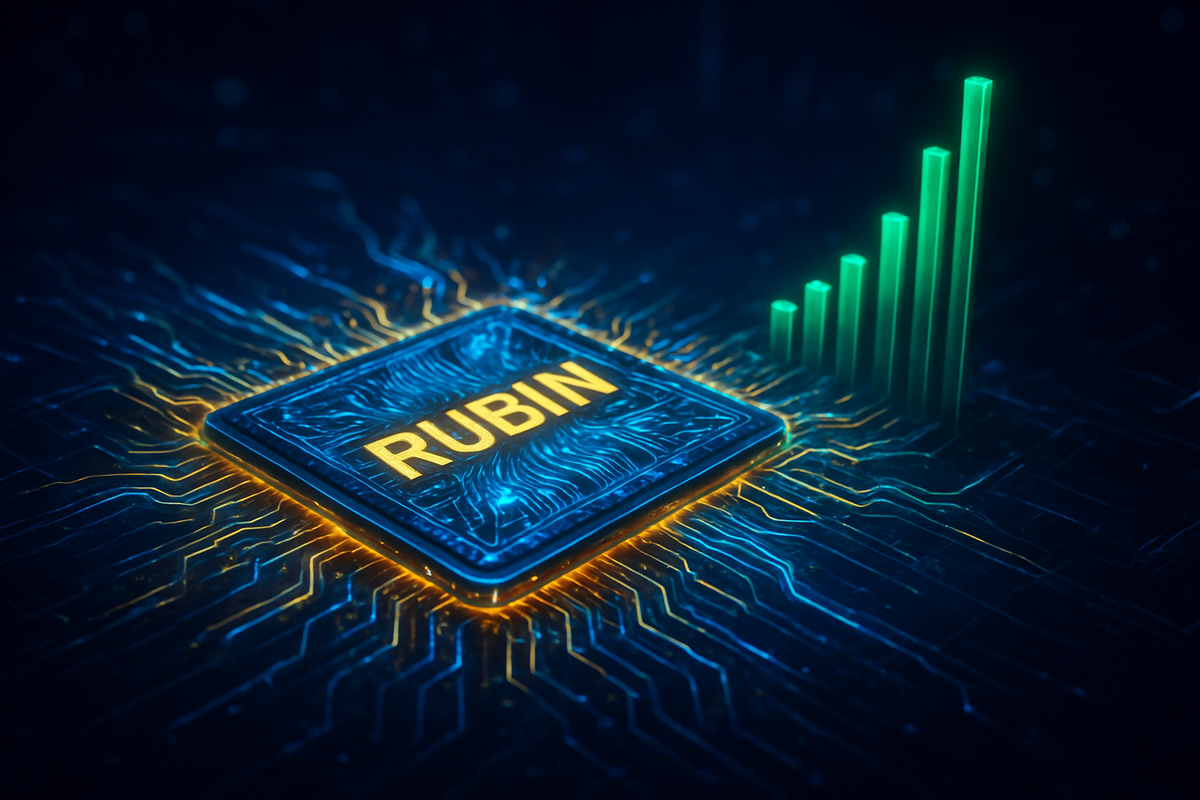
The road to this 10-day winning streak began in late March 2026, following a period of relative stagnation where the stock traded between $165 and $185. The catalyst for the breakout was twofold. First, NVIDIA management decisively moved to quash persistent rumors regarding a costly acquisition in the stagnant PC hardware sector, which had weighed on margins. Second, the company’s "GTC 2026" keynote earlier this month provided a concrete roadmap for the transition from the successful Blackwell Ultra (B300) architecture to the highly anticipated "Rubin" R100 series, scheduled for release in the second half of this year.
This rally has been characterized by heavy institutional buying, with major exchange-traded funds (ETFs) reweighting their portfolios to account for NVIDIA’s expanding Total Addressable Market (TAM). Market analysts noted that the streak was not merely a result of hype but was underpinned by the massive pre-orders for the GB300 "Superchip," which has become the gold standard for sovereign AI projects in Europe and the Middle East. Initial reactions from Wall Street have been overwhelmingly bullish, with several top-tier firms raising their price targets to the $220 range, citing NVIDIA’s ability to maintain a 75% to 86% share of the data center AI accelerator market despite intensifying competition.
The Competitive Landscape: Winners and Losers in the AI Arms Race
While NVIDIA (NASDAQ: NVDA) basks in the glow of its longest streak since 2023, the ripple effects are being felt across the sector. AMD (NASDAQ: AMD) remains the most formidable challenger, having recently secured a landmark $60 billion supply agreement with Meta to provide its MI325X accelerators. While AMD’s market share has grown to 13%, the company faces the daunting task of matching NVIDIA’s yearly release cadence. For investors, AMD represents a high-value "second source" alternative, but it has yet to break NVIDIA's software moat, centered around the CUDA-X ecosystem.
On the other hand, Intel (NASDAQ: INTC) has found itself in a bifurcated position. While Intel's Gaudi 4 accelerators have struggled to gain significant traction in the high-end data center market—holding roughly a 6% share—the company has emerged as a winner in the "AI PC" segment. By early 2026, Intel-powered NPU (Neural Processing Unit) laptops have captured over 55% of the consumer market, providing a stable revenue base even as they play catch-up in the cloud. Meanwhile, the upcoming IPO of Cerebras, the wafer-scale engine pioneer, is expected to introduce a new "wildcard" competitor that could challenge NVIDIA in specialized, massive-scale training clusters.
The Wider Significance: Beyond the Ticker Symbol
NVIDIA’s performance is a bellwether for a broader shift in the tech industry’s structural philosophy. The transition from the Blackwell architecture to the Rubin architecture signifies a move toward 3nm process nodes and HBM4 memory, technologies that were considered experimental just 24 months ago. This "generational lag" that NVIDIA maintains over its competitors is now being used as a strategic barrier to entry, forcing rivals to compete on price rather than peak performance.
Historically, the November 2023 streak was fueled by the "discovery phase" of AI, where enterprises were scrambling to understand ChatGPT's implications. In contrast, the April 2026 streak is fueled by the "deployment phase." We are now seeing the rise of "Rubin CPX," specialized variants of chips designed specifically for long-context inference. This suggests that the industry is moving away from a one-size-fits-all GPU approach toward a more nuanced hardware ecosystem. Furthermore, NVIDIA’s late-2025 acquisition of assets from Groq has effectively neutralized the threat of specialized Language Processing Units (LPUs), integrating high-speed inference directly into the NVIDIA stack.
Looking Ahead: The Road to Rubin and Feynman
In the short term, all eyes are on the H2 2026 launch of the Rubin architecture. Market participants are watching for any supply chain bottlenecks in HBM4 memory production, which could potentially cap NVIDIA's upside. However, the long-term outlook remains aggressive. NVIDIA has already begun teasing its 2028 architecture, codenamed "Feynman," which is expected to utilize a 1.6nm process. This relentless pace of innovation suggests that NVIDIA is not just selling chips, but is effectively setting the speed of global computational progress.
Strategic pivots may be required if regulatory pressure intensifies. As NVIDIA’s market cap continues to rival the GDP of mid-sized nations, antitrust scrutiny in both the US and EU remains a persistent tailwind risk. Investors should also monitor the shift toward custom ASICs (Application-Specific Integrated Circuits) being developed by hyperscalers like Google and Amazon. While these internal chips haven't dethroned NVIDIA, they represent a growing "ceiling" on how much market share NVIDIA can reclaim in the sovereign cloud sector.
Closing Thoughts: A Market Defined by One Name
The achievement of a 10-day winning streak in April 2026 serves as a powerful reminder of NVIDIA’s gravitational pull on the modern economy. The company has successfully navigated the transition from a "pandemic-era darling" to the "industrial backbone" of the 21st century. As the stock approaches the $200 psychological barrier, the focus shifts from whether NVIDIA can grow to how much faster it can outpace an entire industry that is trying to catch up.
For investors, the key takeaways are the strengthening of the yearly product cycle and the successful expansion into Quantum AI and Agentic hardware. While the volatility inherent in the semiconductor space has not vanished, the floor for NVIDIA appears to have been raised significantly. Moving forward, the most critical metrics to watch will be the "Rubin" production yields and the adoption rates of the Ising platform. As of now, NVIDIA remains the undisputed protagonist of the AI era, with its 10-day streak acting as a loud proclamation of its continued relevance.
This content is intended for informational purposes only and is not financial advice.